
[Number 22 in my chronological re-read of all of Anita Brookner’s 24 novels.]
Time, as in duration, plays a huge role in all of Anita Brookner’s novels. Most of her protagonists appear to be biding their time, seemingly waiting for some sort of anything to happen. More often, they are waiting for a husband or lover to come home from work, or waiting for a reasonable hour to go to bed. And underneath it all, just simply waiting for the end.
Time, as in season, is also huge. Although, in some ways even this refers back to characters biding their time–waiting for long summer nights to end so they can go to bed. Or the corollary, waiting for the early winter darkness to allow an early bedtime. And of course, their long, London walks are taken against a backdrop of a warm summer night, or a chill, foggy, winter day.
Time, as in the year of our Lord, however, plays very little role. Topical events, if they appear at all, are only barely mentioned and with very little specificity. On the few occasions they are included, they are obliquely referred to, and then only to suggest the zeitgeist that may or may not be an influence, or explain a character’s actions or personality. And so it is with The Rules of Engagement. But more on that in a minute.
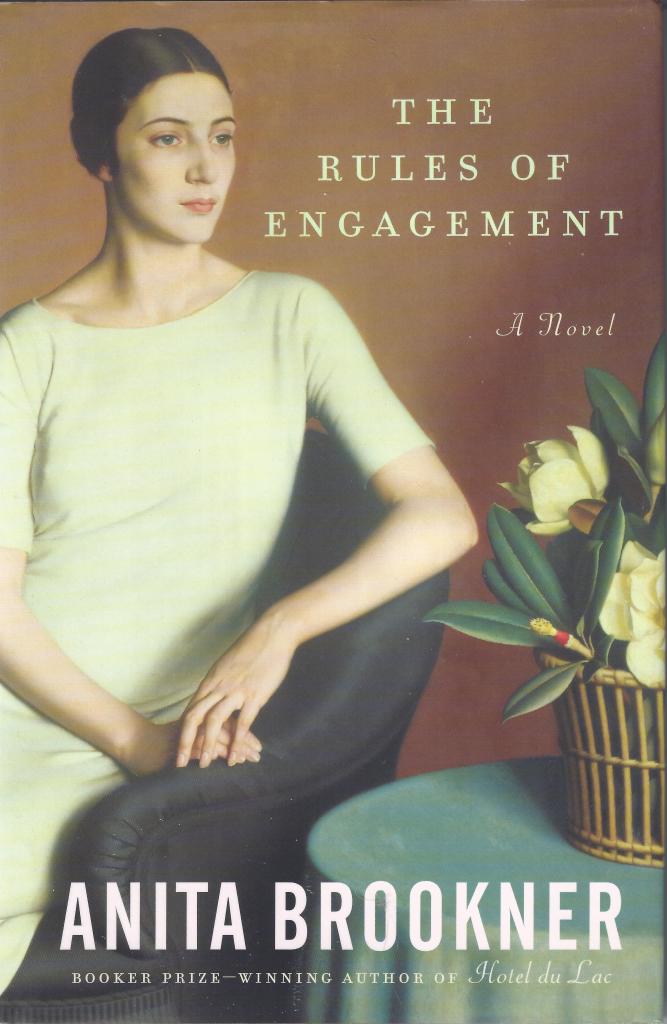
Elizabeth Wetherall traces her almost lifelong relationship with her school friend Betsy. Elizabeth and her stable, comfortably off family, provide a haven for Betsy who lives with her widowed father, and whose instability as a parent is summed up by the presence of a spinster aunt to look after her, and his tarnished professional reputation. Throughout their lives, the relationship between Elizabeth and Betsy will remain similarly lopsided, even if the balance of success/happiness/envy shifts back and forth between them over the years. This imbalance is never really identified as such by Elizabeth, and Betsy’s state of mind is left either completely unknown, or only discernable as a third party.
Elizabeth is at an advantage during their childhood, but then Betsy has a rather more exciting life in the middle of the student turmoil of late 1960s Paris, which is also set against Elizabeth’s safe but unexciting marriage to Digby who is more than a few years her senior. Elizabeth possibly returns to the upswing with her affair with the married Edmund, but shifts back again when she ends the affair and, upon her return to London, Betsy begins an affair with him.
Betsy’s affair with Edmund, at least at first, included all the things that Elizabeth’s did not. Over the extended period of Elizabeth’s affair with him, she spent most of her time waiting for their assignations in the churchyard of St Luke’s (the church where, as Brookner notes, Dickens was married). She quickly learns that no part of Edmund’s real life is open to her. Despite having met his wife at numerous dinner parties with her own husband, the rules of their engagement forbid her from asking him about her or his life in general, or expecting any information whatsoever about anything beyond what they do in his pied-à-terre. She watches as Betsy begins her affair with Edmund and insinuates her way into Edmund’s family in a way Elizabeth would never have dared (or wanted?). Betsy maintains her sexual relationship with him while becoming a kind of part-time unpaid governess to his children. Watching all of this play out, Elizabeth’s envy, or perhaps resentment, turns to vicarious horror–although, this is Brookner, horror is far too strong a word–as Betsy vastly overstays her welcome with Edmund’s family and becomes an albatross Edmund can’t shake.
The quiet, but tragic ending of Betsy’s affair with Edmund set’s the stage for what appears to be the final phase of Elizabeth’s life. There is, what we can assume is, an affair with Nigel Ward, a warden of sorts at a London college who shepherds international students on long walks around London. But this peters out amicably over time and leaves Elizabeth more on her own than ever. We are left at the end of the book with Elizabeth biding her time for not much of anything. It is perhaps unfair to say she has nothing in her life. She does voluntary work at a hospital and has women friends, but it is hard argue that this constitutes any sort of life given that these things take up exactly two sentences on the final page of the book. Perhaps it was Brookner’s intention just to tell the story of Elizabeth and Betsy and the rest has no bearing on her intent. But the bleakness and resignation in the closing paragraphs don’t leave the reader with much hope. Elizabeth finds herself fixated on the faces of children she sees, and the joy on her own face that is ostensibly buried forever deep in her own childhood. At the age of 56, she seems literally to be waiting for the end.
According to the tabloid which I now read over breakfast, fifty is the new thirty. But this is not true: at thirty, one still has expectations.
 Brookner Place