What’s the most Londony Brookner novel?

I finally crunched the London place name data for all 24 of Brookner’s novels. This is the number of unique London place names mentioned in each book. (For a list of place names in all of Brookner’s novels, click here.)

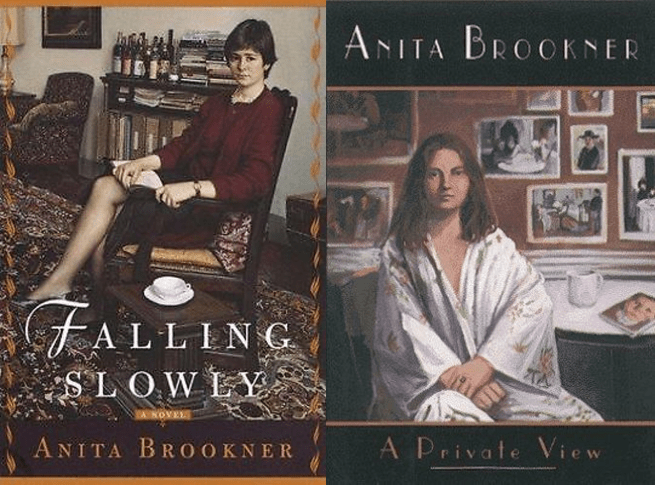
47 – Falling Slowing
47 – A Private View
44 – Undue Influence
43 – A Family Romance (Dolly)
41 – Fraud
40 – Brief Lives
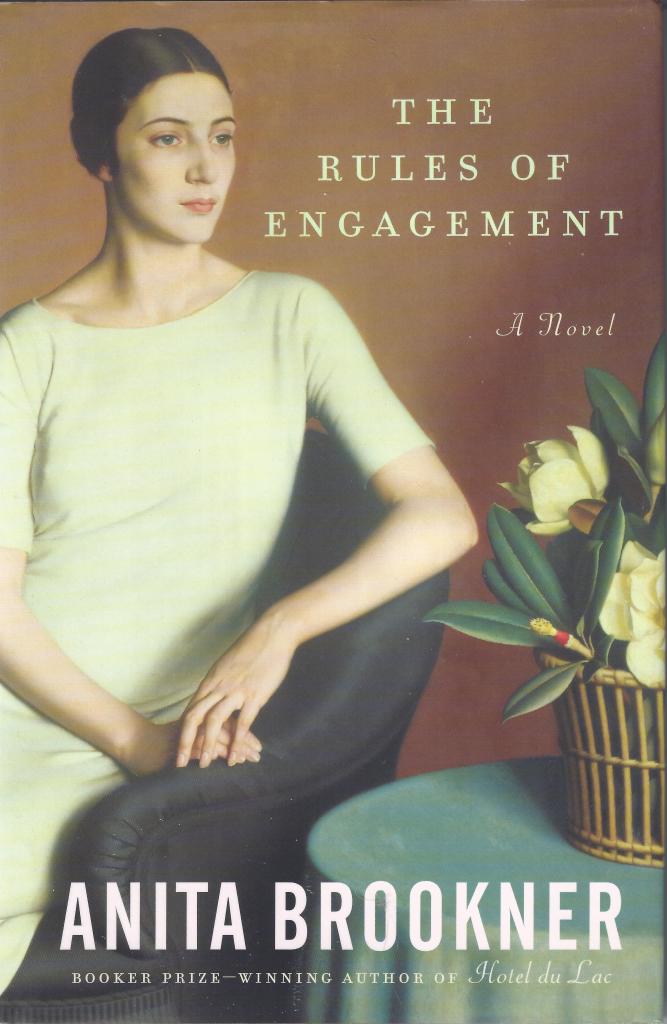
38 – The Rules of Engagement
35 – Lewis Percy
34 – A Closed Eye
32 – Altered States
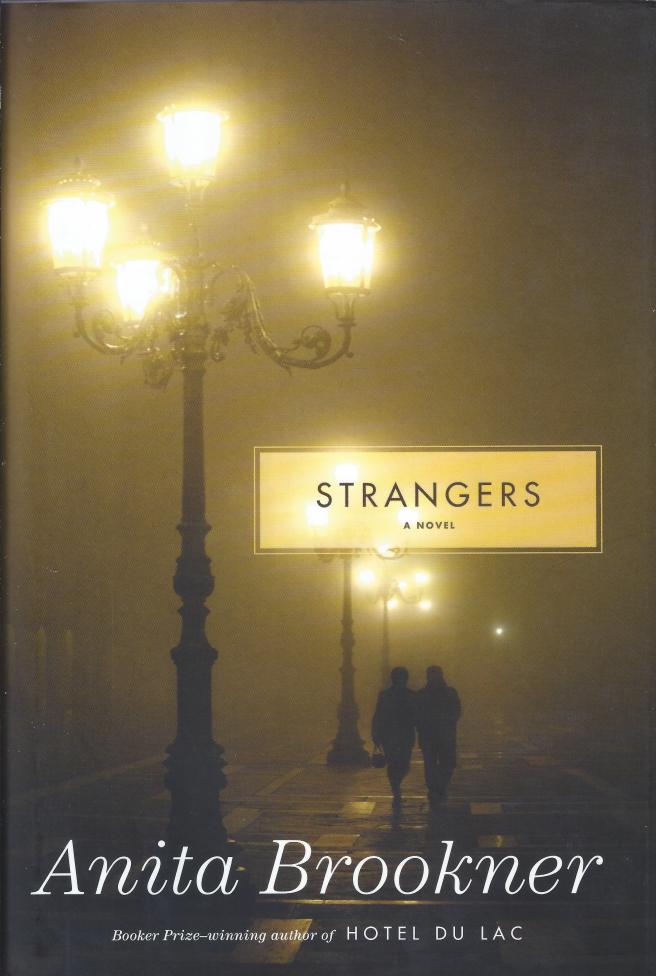
32 – Strangers
31 – Latecomers
28 – Visitors
23 – The Bay of Angels
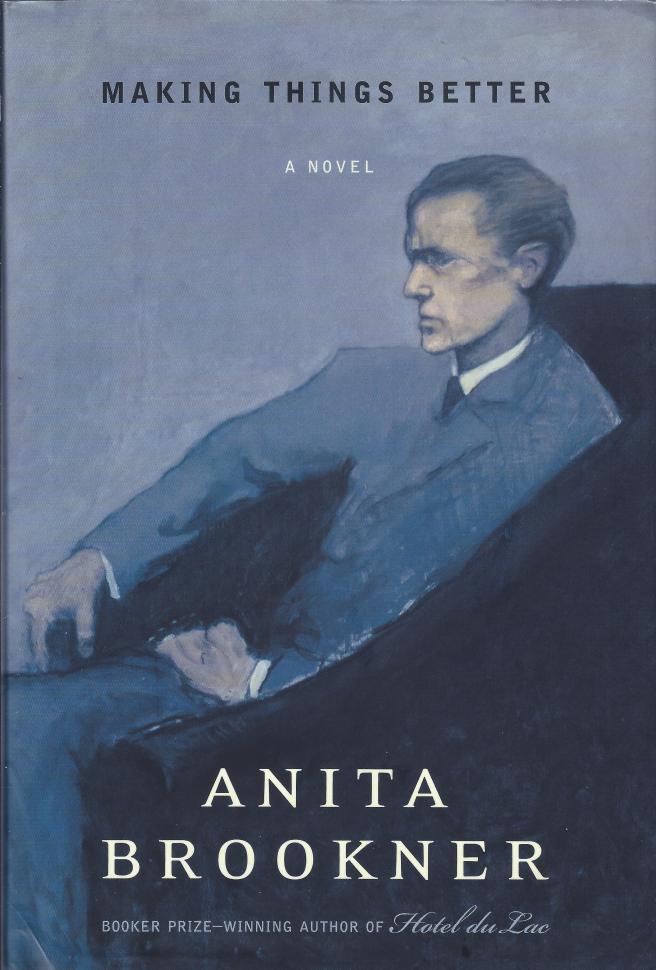
21 – The Next Big Thing (Making Things Better)
20 – Look at Me
13 – A Friend from England
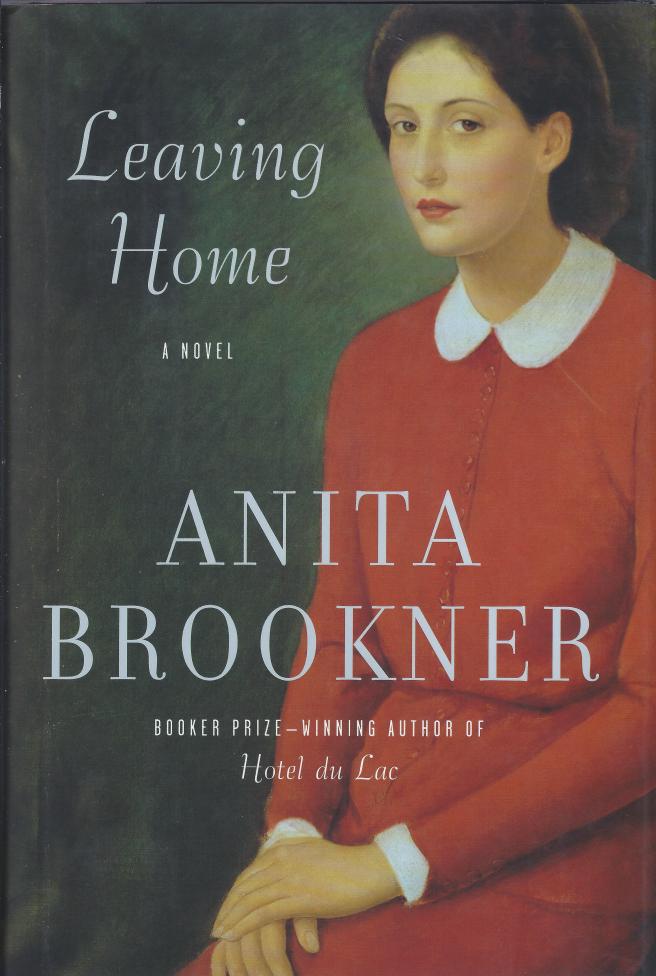
13 – Leaving Home
11 – Family and Friends
11 – Incidents in the Rue Laugier
11 – The Misalliance
9 – A Start in Life (The Debut)
7 – Hotel du Lac
7 – Providence

The least Londony Brookner Novel?

I’ve finally gotten the London placenames into a spreadsheet and will be able to start crunching the data. In the meantime, here are the answers to a little Twitter poll I’ve conducted.

The novels with the fewest London place name mentions:

Family and Friends – 12

Incidents in the Rue Laugier – 12

The Misalliance – 12

A Start in Life/The Debut – 9

Hotel du Lac – 7

Providence – 6

Review: Strangers

[The last in my chronological re-read of all of Anita Brookner’s 24 novels.]

In my review of Leaving Home just a month and a half ago, two days before my 58-year old husband died unexpectedly, I wrote this:

I am now the age (52) Brookner was when she published her first novel. I have often felt myself a bit of a Brookner character. There was even a point at age 33, and just weeks before meeting the man who would become my husband, that I told a friend I had made peace with the fact that was going to be alone forever and was okay becoming a Brookner character.

In the fog of grief, I don’t remember if I read this opening line of Strangers before John died, or after:

Sturgis had always known that it was his destiny to die among strangers.

Some of you may be scratching your heads wondering why in the world I would pick up this book just four days after John died. But I do remember it was already on my nightstand and it actually proved to be pretty comforting. As I alluded to in my review of Leaving Home, I pretty much thought my life with John had inoculated me against becoming a Brookner character. Given that he was six years older and had a fair amount of chronic health issues from cancer treatment he had when he was 20, I assumed at some point I would be alone. But I must say, it came about 20 years sooner than I ever would have anticipated.

So here I am at 52, just four months short of 20 years with John, I find myself a widower. And still determined not to be a Brookner character. Perhaps even more determined than before.

Paul Sturgis is about 72, retired, never married, and the only reoccurring characters in his life are Helena, and aging widow of a distant cousin, Sarah, and aging ex-girl friend who went on to marry and become a widow by the time of this novel, and Vicky a younger (but not young) almost divorced woman who Paul met at a cafe in Venice. It turns out none of these relationships have anything that will keep Paul from feeling alone. But then we get what is a happy ending for a Brookner novel. The last paragraph:

Quietly he replaced the receiver. Just as quietly he picked up his bag, closed the door behind him, and set out for France, beginning his journey to another life. Making it new.

And that is what I need to do. I need to make it new. John would be the first person to tell me to wring the hell out of the rest of my life. With multiple bouts of tears on a good day, it is far too early to know what that might mean. But I know it is true.

This review is no good. I’m generally not that good anyway, and, annoyingly, for the first time in my history with WordPress, it froze and didn’t save my work when I had finished a much better review than this about 23 minutes ago. But here is the deal, after reading Brookner’s 24 novels twice each, I can boil down to this: they are all the same book. I know it’s overly simplistic and shows my lack of literary training, but damn if it isn’t true. I love all of them, and look forward to reading them all a third time. They are immensely well-written, the prose glitters in its spare precision. But they are all pretty damn similar. For those that like them, this is a blessing, not a curse.

Review: Leaving Home

[Number 23 in my chronological re-read of all of Anita Brookner’s 24 novels.]

After reading a few contemporary reviews of Leaving Home, one gets the feeling that reviewers, if they hadn’t previously, had gone cold on Brookner’s 23rd iteration of the same story. Of course this is a simplistic view of both the reviewer’s points of view and Brookner’s work itself, but I have myself often referred to the sameness of these novels. The key difference between me and the reviewers, however, is that I haven’t tired of Brookner’s formula. With only one more novel in my re-read, I have read 47 Brookner novels and after I finish the 24th for the second time, I know I will be back in the future to read most, if not all, of them again.

In Leaving Home, Emma Roberts, although still young, looks back on her life and her various life choices in a way that suggests she feels powerless to alter her trajectory. One gets the feeling that her leaving home to pursue post-graduate studies on classical garden design in Paris, and all of her experiences there, don’t seem to her, in retrospect, as amounting to much. It’s not enough that she did these things, she describes them in a way that implies she was powerless throughout. She seems to fall into everything that happens to her, from her research, to her relationships with Michael, Philip, and her only French friend, Françoise. Even her decisive action when she is forced into a rather horrific situation with Françoise’s maman in a decaying house in the French countryside seems inconsequential enough to alter the trajectory of her life.

I am now the age (52) Brookner was when she published her first novel. I have often felt myself a bit of a Brookner character. There was even a point at age 33, and just weeks before meeting the man who would become my husband, that I told a friend I had made peace with the fact that was going to be alone forever and was okay becoming a Brookner character. In many ways this too is overly simplistic. I could never be as passive as one of Brookner’s heroines, but I could relish a solitary life to the point where loneliness and the indignities of the forever-single would make my splendid isolation more tragic than comforting. Although some of Brookner’s characters have led lives of agency off the pages, either before or during the action of the novel, it is never described explicitly enough to convince us that it amounted to much.

After about 25 years of reading Brookner, and sliding into an age bracket where one turns into something without fully realizing it, there are still parts of me that find the lives of her characters desirable. I used to think I would keep young people in my life in a way that would keep me engaged in the world, but the more I deal with Millennials and younger, the less I want to deal with anyone younger than myself. I’m not singling out those cohorts, I’ve just come to understand why old people often aren’t as interested in the young as the young think they should be. This isn’t, of course, the point of Leaving Home, but it is what’s on my mind as I contemplate Brookner’s distinctive world.

For as long as I have worried about becoming a Brookner character, I have also taken an inordinate pride in the fact that I have left home, literally and metaphorically, many times in my life. Leaving for college, leaving to work abroad, moving across the country for a boyfriend, moving to Hawaii sight unseen, moving back to Minnesota (my home state) and leaving a good job after three years to get a second master’s degree in upstate New York, and moving yet again to land here in DC. I still rattle this off wanting to give you even more detail–my leaving places is part of my identity. But after 20 years in one spot and being happy to stay for another 20, my need for you to know of my past is no greater evidence of the fact that I fear becoming a Brookner creation more than welcome it.

In the end, I may have no more choice than Emma in Leaving Home. It’s not that she hasn’t lived, it’s that none of her choices keep her from a fate that seems pre-ordained from the outset. Since Emma describes her life in retrospect, it’s impossible to know if she knew where her choices (or lack thereof) were leading her, but maybe that is the point. We can leave home as many times as we want, it’s not going to keep us from becoming what we become.

Review: The Rules of Engagement

[Number 22 in my chronological re-read of all of Anita Brookner’s 24 novels.]

Time, as in duration, plays a huge role in all of Anita Brookner’s novels. Most of her protagonists appear to be biding their time, seemingly waiting for some sort of anything to happen. More often, they are waiting for a husband or lover to come home from work, or waiting for a reasonable hour to go to bed. And underneath it all, just simply waiting for the end.

Time, as in season, is also huge. Although, in some ways even this refers back to characters biding their time–waiting for long summer nights to end so they can go to bed. Or the corollary, waiting for the early winter darkness to allow an early bedtime. And of course, their long, London walks are taken against a backdrop of a warm summer night, or a chill, foggy, winter day.

Time, as in the year of our Lord, however, plays very little role. Topical events, if they appear at all, are only barely mentioned and with very little specificity. On the few occasions they are included, they are obliquely referred to, and then only to suggest the zeitgeist that may or may not be an influence, or explain a character’s actions or personality. And so it is with The Rules of Engagement. But more on that in a minute.

Elizabeth Wetherall traces her almost lifelong relationship with her school friend Betsy. Elizabeth and her stable, comfortably off family, provide a haven for Betsy who lives with her widowed father, and whose instability as a parent is summed up by the presence of a spinster aunt to look after her, and his tarnished professional reputation. Throughout their lives, the relationship between Elizabeth and Betsy will remain similarly lopsided, even if the balance of success/happiness/envy shifts back and forth between them over the years. This imbalance is never really identified as such by Elizabeth, and Betsy’s state of mind is left either completely unknown, or only discernable as a third party.

Elizabeth is at an advantage during their childhood, but then Betsy has a rather more exciting life in the middle of the student turmoil of late 1960s Paris, which is also set against Elizabeth’s safe but unexciting marriage to Digby who is more than a few years her senior. Elizabeth possibly returns to the upswing with her affair with the married Edmund, but shifts back again when she ends the affair and, upon her return to London, Betsy begins an affair with him.

Betsy’s affair with Edmund, at least at first, included all the things that Elizabeth’s did not. Over the extended period of Elizabeth’s affair with him, she spent most of her time waiting for their assignations in the churchyard of St Luke’s (the church where, as Brookner notes, Dickens was married). She quickly learns that no part of Edmund’s real life is open to her. Despite having met his wife at numerous dinner parties with her own husband, the rules of their engagement forbid her from asking him about her or his life in general, or expecting any information whatsoever about anything beyond what they do in his pied-à-terre. She watches as Betsy begins her affair with Edmund and insinuates her way into Edmund’s family in a way Elizabeth would never have dared (or wanted?). Betsy maintains her sexual relationship with him while becoming a kind of part-time unpaid governess to his children. Watching all of this play out, Elizabeth’s envy, or perhaps resentment, turns to vicarious horror–although, this is Brookner, horror is far too strong a word–as Betsy vastly overstays her welcome with Edmund’s family and becomes an albatross Edmund can’t shake.

The quiet, but tragic ending of Betsy’s affair with Edmund set’s the stage for what appears to be the final phase of Elizabeth’s life. There is, what we can assume is, an affair with Nigel Ward, a warden of sorts at a London college who shepherds international students on long walks around London. But this peters out amicably over time and leaves Elizabeth more on her own than ever. We are left at the end of the book with Elizabeth biding her time for not much of anything. It is perhaps unfair to say she has nothing in her life. She does voluntary work at a hospital and has women friends, but it is hard argue that this constitutes any sort of life given that these things take up exactly two sentences on the final page of the book. Perhaps it was Brookner’s intention just to tell the story of Elizabeth and Betsy and the rest has no bearing on her intent. But the bleakness and resignation in the closing paragraphs don’t leave the reader with much hope. Elizabeth finds herself fixated on the faces of children she sees, and the joy on her own face that is ostensibly buried forever deep in her own childhood. At the age of 56, she seems literally to be waiting for the end.

According to the tabloid which I now read over breakfast, fifty is the new thirty. But this is not true: at thirty, one still has expectations.

Review: The Next Big Thing / Making Things Better

[Number 21 in my chronological re-read of all of Anita Brookner’s 24 novels.]

Julius Herz has spent his life trying to make things better. In big ways for his parents and his brother, and in smaller ways for most everyone else he bumps into. It’s easy to see why Brookner (or her publisher) decided on this as the U.S. title. Indeed the title pops up multiple times in the text. It is a little harder to see why the U.K. title (and presumably the original title) is The Next Big Thing. There are a few next big things here and there, but in true Brookner style they don’t seem that big, and in even truer Brookner style, most of them don’t amount to anything, even on the few occasions where Herz actually goes through with them. There is certainly the next big thing that plays out in the final chapter of the book, but it doesn’t necessarily wash away all the decades of making things better.

Refugees of Nazi Germany, Julius, his brother Freddy and their parents are installed in a flat in Hilltop Road by Ostrovski a connection of a friend of a relative. Ostrovski also gives Herz’s father a job in a record shop he owns and later also employs Herz. After they relocate to London, brother Freddy suffers an obliquely described breakdown that relegates him to lead an off-stage existence in a sanitorium and later hospice in Brighton. Freddy’s ultimately thwarted, but prodigious musical talent, and their parent’s focus on it stand in contrast to their general ingratitude toward, and neglect of Herz. It is true that they pretty much disown Freddy as soon as it is clear he won’t be pursuing the musical career they had driven him to, but throughout one has the distinct impression that what he was, and could have been, remained more important to them than any of the countless daily acts of support that Herz provides.

Forced into a financially comfortable retirement by Ostrovski’s decision to sell off Herz’s flat and the record shop where Herz worked his entire adult life, Herz’s present day life is a dull succession of reflection and inertia. There is his first love (and first cousin) Fanny Bauer to think of as well as his ex-wife Josie, but not much else. His boredom and loneliness result in overtures of various consequence to Fanny and Josie as well as a rather tragic and wholly misjudged overture to a young neighbor. In fact, it might be that indiscretion with the neighbor Sophie that startles Herz into more appropriate action with Fanny and Josie.

As with all Brookner novels, the lack of movement on the surface belies more themes than any book club could handle in one session. There is an elision of time that contracts and expands the temporal distance between events and conditions described. How long did they live on Hilltop Road before moving into the much smaller flat above the shop? How long did Herz continue to work in the shop after his parents died? How much time was there in between his parent’s death and Freddy’s death? Exact details aren’t needed, but the lack of clarity says something about Herz’s recollections and probably his life itself.

Then there is all the reading between the lines about Herz’s youth. Questions about Freddy’s breakdown and Ostrovski’s role. Themes dealing with outsider/refugee status, the post-war Jewish diaspora, socio-economic caste and their lives above the store. Indeed in The Next Big Thing Brookner uses about 70 more pages than she typically does. I’ve read it twice now and have gone back and re-read passages while compiling the place names for Brookner’s London, and am struck by the depths left to plumb. Not the least of these is the next big thing(s) that round out the book.

Review: The Bay of Angels

[I’m up to number 20 in my chronological re-read of all of Anita Brookner’s 24 novels.]

I often don’t like reading the synopsis of a novel prior to reading it. I’m always afraid of it giving too much away. Kind of like a movie trailer that packs so much into three minutes you begin to think they have given away the entire movie. I’m not sure why I feel this way about blurbs on books. As soon as I begin to read the book itself, it is rare that I remember anything about the blurb. Everything that happens is about as surprising to me as if I hadn’t read any blurb. And so with The Bay of Angels, I didn’t read the front jacket flap until I sat down to write this review. It equates Zoë Cunningham’s outlook on life with her childhood fascination with fairy tales. This rang no bells for me. Fairy tales? When does that come up?

And then I open the book and read the opening line…keep in mind, by this point I have read the novel twice–although the first time was 19 years ago…

I read the Blue Fairy Book, the Yellow Fairy Book, and the stories of Hans Anderson, the Brothers Grimm, and Charles Perrault.

Not entirely sure how I forgot that set up, especially since Brookner goes on for another page a half describing how Zoë’s immersion in fairy tales set her up to expect some sort of outside force to be the sole mechanism for making any sort of change to life. She sees everything through that lens, at least as it applies to her own life and that of her unhappy mother.

One simply had to exist, in a state of dreamy indirection, for the plot to work itself out. This was a moral obligation on the part of the plot: there would be no place for calculation, for scheming, for the sort of behavior I was to observe in the few people we knew and which I found menacing.

And so it is that Zoë accepts the solitary, unhappy life of her widowed mother, Anne, as prelude to something better, and sees her own life as something in which she has no real role other than to wait for something to happen. It isn’t long before Anne’s deus ex machina arrives in the form of a second husband, Simon, who whisks her off to sunny Nice to continue their lives in his flat there. Simon also proves to be Zoë’s knight in shining armor, rewarding her own passivity with the gift of a flat ensuring her stability in London while he and Anne begin their new lives together in Nice.

Zoë bumps along with her life in London and boyfriend Adam, the two of them travelling the Continent from time to time during the off season, staying with Anne and Simon on their way through France. After what turns out to be a rather unsuccessful visit, Zoë and Adam slowly make their way back to London where she takes up freelance editing, and Anne and Simon continue their lives in southern France. That is, until another deus ex machina upends Anne’s life and she ends up in private clinic under sedation.

It is in that clinic where Brookner’s world view is amplified in a way that is both beguiling and confusing to a modern reader. I say ‘modern reader’ as if The Bay of Angels were some relic of the past. In fact, published in 2001, the novel is only 20 years old, but like most of Brookner’s fiction, can seem of another time and dimension. So often in Brookner, one has the feeling she is a decade or two out of step. In terms of gender and sexual mores as well as the trappings of life. In Brookner’s novels everyone has a solicitor, or at the very least an accountant, who takes care of all manner of leases, wills, annuities, and other legal and financial instruments that the vast majority of people neither have, nor even think of. (It’s like Trollope without the vicars.) It’s also a world of Harley Street specialists and private clinics where tablets, and less often, injections, play an outsized role and diagnostic testing consists of nothing more than a stethoscope. And so it is in this private clinic in Nice where Anne is installed to recover from an emotional shock. We learn nothing of her diagnosis, we just know that her recovery is going to take some time, involves a fair amount of drugs, and requires extremely limited interaction from Zoë.

Perhaps there is a world of private clinics like this that exist for the worried well, who can afford it, where they can give up all worry and control to a cadre of healthcare staff. Indeed, in some ways it reminded me of the clinic in the south of Spain that plays a central role in Deborah Levy’s novel Hot Milk, in which a daughter’s story plays out while her mother receives highly personalized care for some extended, unexplained malady. Or perhaps it is just a way for Brookner to cast a fairy tale spell on a character.

With her mother in the clinic, Zoë takes a room in Nice to be close at hand. Without a clear indication of her mother’s outcome and uncertainty about her own outcome, a restlessness takes over as Zoë yearns for stimulation. Noise, activity, human interaction. As her mother’s circumstances only allow for the hand of fate, Zoë seems less content to wait for fate to direct her own life. She realizes in a slow, subtle, Brooknerian way, that her fate cannot be left to some fairy tale outcome, that her existence, her happiness, require exercising some kind of will. I don’t think the lesson is as facile as the realization that passive acceptance is in itself not passive, but rather a realization that each of those fairy tale characters had an untold backstory that guided their fates. I am, perhaps, imposing too much of myself on Brookner’s intent, but even up to the last two pages Brookner seems to be of two minds. On the one hand Zoë is prepared to take whatever life throws at her and accepts that whatever her future is, her story isn’t over and whatever unfolds unfolds. On the other hand, and to my mind, more importantly, she also realizes that a thousand small compromises need to be made if one is to have a shot at happiness. Small movements one direction or another can tempt fate one way or the other and Zoë has decided, however passively, that her fate is to be happy rather than tragic.

…I am reminded once again that I have been fortunate, and that my continued good fortune depends on tact, on discretion, on clearsightedness. These qualities are not beyond me. I am not without resource, should it become necessary. For the moment all is well. The future is, in sense, taken care of: it is in another’s hands. And in mine, perhaps, but I decide not to think ahead.

Brookner and a Bathtub

[A Brookneresque day trip to Torino in February 2019. Originally posted in somewhat altered form at Hogglestock.]

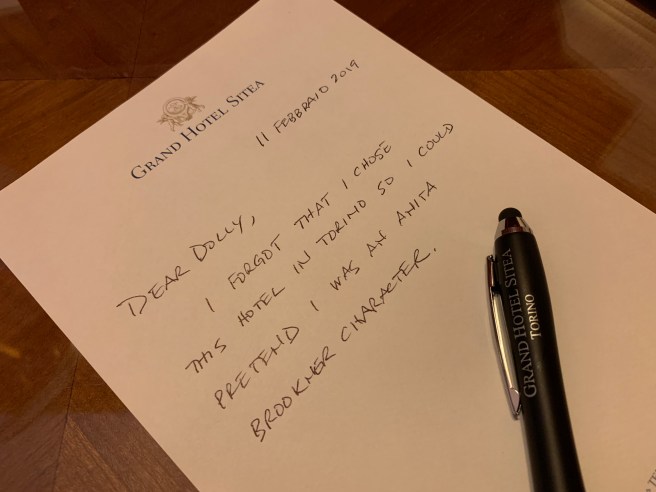
When I was looking online for a hotel for a night in Turin, I did as I typically would do and tried to find some cool boutique hotel in an interesting neighborhood. There were some pretty good options, but I decided I wanted something close to the train station and/or the Teatro Regio. In making that choice I was somewhat limited in my choice of the types of hotels available. As I started to comb through the rather uninspiring options I thought “you’ll be Alps-adjacent, why not stay in a grand old hotel that an Anita Brookner character might choose?” Something that looks like it would have porters and telegrams and mature women travelling with their adult daughters.

The thing is, by the time my trip rolled around months and months later, I had forgotten about this Brookner-related choice. And then an interesting thing happened on the train…

When I bought my train ticket for the one-hour trip from Milan to Turin I somewhat impulsively chose a first class ticket. The price difference wasn’t all that much and given some tummy issues I had been having, anything I could do to minimize possible annoyances seemed like a good idea. As I sat comfortably in my seat watching the snow-capped mountains in the distance I noticed this character…

My first thought was that she looked like someone who could be one of the more glamorous characters in a Brookner novel. (Again, I had totally forgotten about my Brookner-related hotel choice.) Then the gentle lady spoke to her husband. She was English. Check. They were discussing how the 59-minute train delay was going to make them miss their connection to Switzerland. Check. It seems they are English but have a house in the Swiss Alps. Check. Then she gets on the phone to someone (a housekeeper perhaps?) in Switzerland to tell her they wouldn’t be arriving until the next day and asking how much snow there had been and whether the huskies had been out yet. Check and check. I’m pretty sure Brookner never overtly discussed the snow in Switzerland in her novels or mentioned many dogs, and certainly not huskies. But seriously, how could this woman not be a secondary Brookner character? I almost asked her if her name was Dolly.

So then I got to my hotel in Turin, feeling both tired and still nursing the dull pain in my stomach, and it slowly began to dawn on me that this was to be my Brookner hotel.

If I had stayed true to Brookner form I should have had tea sent up to my room, but I didn’t.

I made it an early night and was asleep by 9:30. Check. It was a warm room, perhaps too warm, and I had fitful but dreamless sleep. Very Brooknerian. Check.

Rather than feel the need to do much in the way of sightseeing the next morning, I took a long hot bath and lounged in my room until check out time. Check and check.

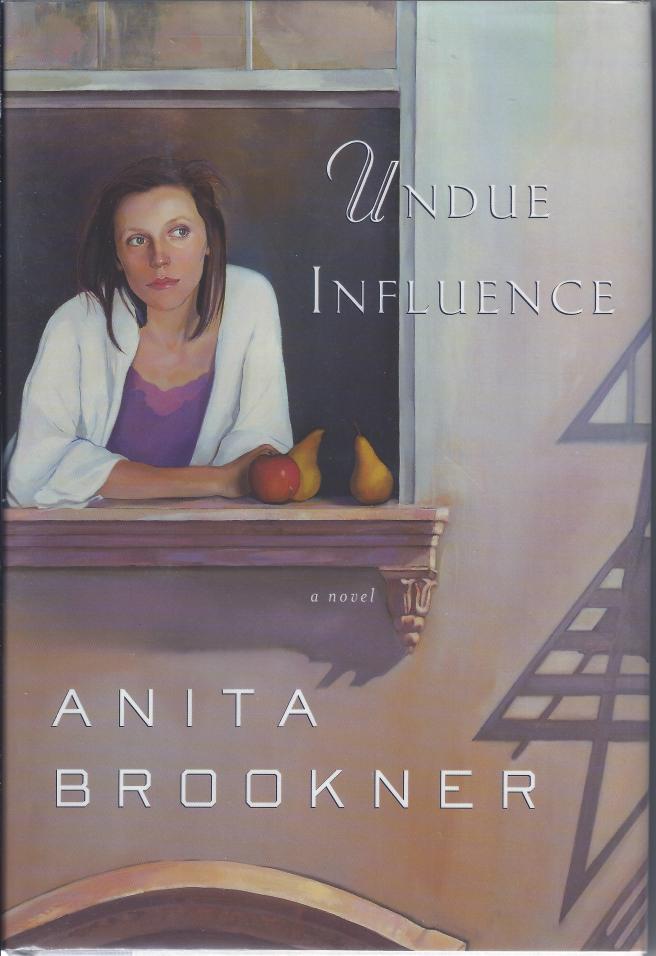
Review: Undue Influence

[I’m up to number 19 in my chronological re-read of all of Anita Brookner’s 24 novels.]

In her 19th novel, published in 1999, Brookner’s characters are starting to feel like they might actually have inhabited the year in which they were written. Her mention of the Eurostar which had only begun operations about five years earlier seems like a fantastically contemporary reference for Brookner. (In her 18th novel, Falling Slowly published the previous year, there is a journey to France that seems likely to have been made on Eurostar, but one has to be a bit of a transportation nerd with a touch of OCD to even read that much between the lines.) But it isn’t just one mention of Eurostar that makes this Brookner novel seem almost fresh. Her protagonist in Undue Influence is a youngish woman, Claire Pitt, who clearly hasn’t figured out where she is headed in life.

Somewhat recently orphaned by the death of her mother, Claire is working in the basement of a used bookshop where she is transcribing the writings of St. John Collier, the late father of the Misses Colliers who run the bookshop they inherited from him. As the transcription work winds down she becomes a default employee when Muriel Collier needs to stay at home to take care of her sister Hester. The two of them have never married and in their own way never really matured. Muriel, now in her 80s, believes their father drew them into the business as a way to keep them unmarried and close at hand.

It seems like Claire might suffer a similar outcome. Stunted in her own emotional development by her father’s invalidism after a series of strokes beginning when she was 10, Claire abhors any sign of weakness in men that might remind her of him. She has just one friend, another young woman Caroline, who still goes by Wiggy, no doubt a nickname from school days, who is content being the mistress of a married man. Claire and Wiggy meet for dinner once a week, sharing confidences that never go too deep, and, while not explicitly stated, feel like a relic of girlhood. Her avoidance of her financial standing in the months (years?) after her mother’s death and her assumption, based on nothing but conjecture, that she will be hired by the owner’s of the new shop, suggest someone who is less than ready to face the adult world.

But Claire’s stunted development is no more apparent than in the way she spins endless stories in her head about the people she observes. From imagining that a random man in a cafe is the son of her upstairs neighbor to imagining backstories for just about everybody she becomes acquainted with. And these backstories aren’t the product of a burgeoning writer, they never get written down. They don’t even seem to be consciously created. They just seem to be the day dreams of a child, someone who doesn’t have anything more pressing or tangible to fill up her mind.

Claire’s propensity for daydreaming helps explain how 40-something, widower-in-waiting, Martin Gibson becomes the target of her attention. It allows her to insinuate herself into his life, get him into her bed, and eventually focus on him as her life’s obsession. Keep in mind that all of this is through the Brookner lens so none of it is as dramatic as that sounds. In fact, it is so typically subtle, that I sometimes had to go back a few paragraphs just to see if what I thought happened had really happened.

Even realizing that she has exerted undue influence on Martin and created an imagined  trajectory for their relationship that will likely never come to be isn’t enough to shake her loose from those imaginings. She sabotages what little there is between them, realizing she is pushing him away, but is unable to either stop herself or even realize the likely outcome of her behavior. She doesn’t fully take on board that he is distancing himself, but the reality of it seems to be creeping into the fringes of her subconscious as she becomes aware of a new, but still unexplained condition.

The proof of this was my new inability to speculate. This had always been such a resource, an endowment, even a gift, that its disappearance, however temporary, however ephemeral…left me desolate.

It isn’t until she realizes that Martin has moved on from their superficial connection–relationship really is too strong a word–that the scales finally fall from her eyes. Up to that point she had been trying to convince herself that she was moving on. But even as she planned to go abroad to some unknown destination, she seemed to be planning it all either as a means of distraction, or as something she could return from. A bit of evidence of a life, or maybe as proof independence, that she could point to at some future time when renewing her pursuit of Martin. But with the inescapable truth finally in front of her, all of her denial slips away. All of the non-existent emotional ties she had felt were dissolved. After multiple subconscious sputters and false starts, Claire’s adult future is finally clear. She doesn’t really know what the future is, but she knows what it isn’t. It isn’t Martin, it probably isn’t the bookshop, and it definitely isn’t some castle in the sky with no basis in reality. This could possibly sound bleak, but it is actually one of the more optimistic endings in the Brookner canon. Her life is wide open with nothing to hold her back.

When the heat in my face and throat subsided and I could bear to get up from my chair, I walked to the window and looked out. I must have stood there for some time, because when I turned around the room was in darkness. I had no conscious thoughts. All I knew was that now, as never before, I should find it easy to leave.

Review: Falling Slowly

[I’m up to number 18 in my chronological re-read of all of Anita Brookner’s 24 novels.]

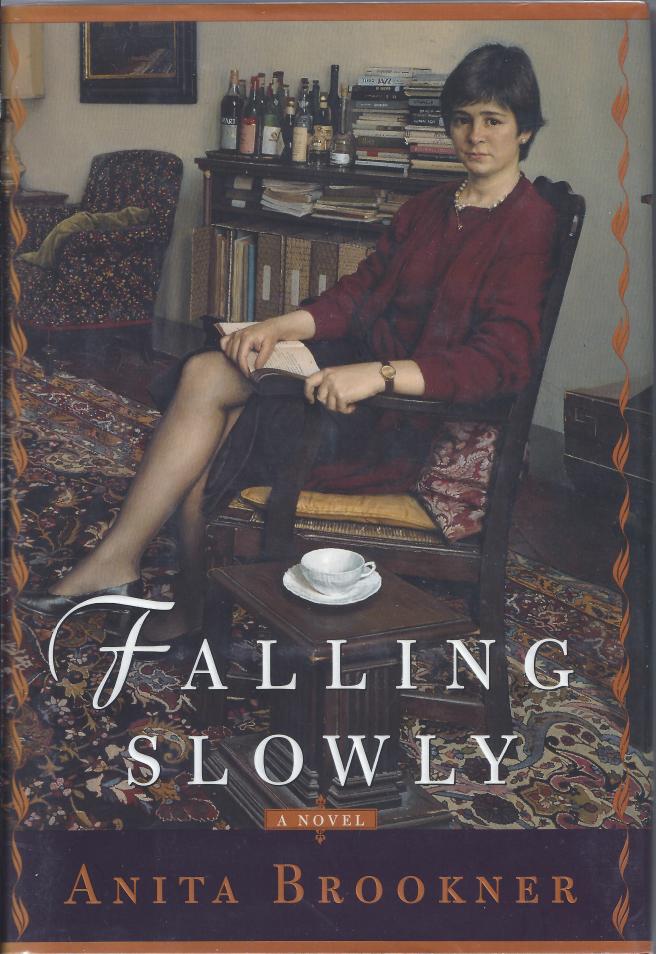
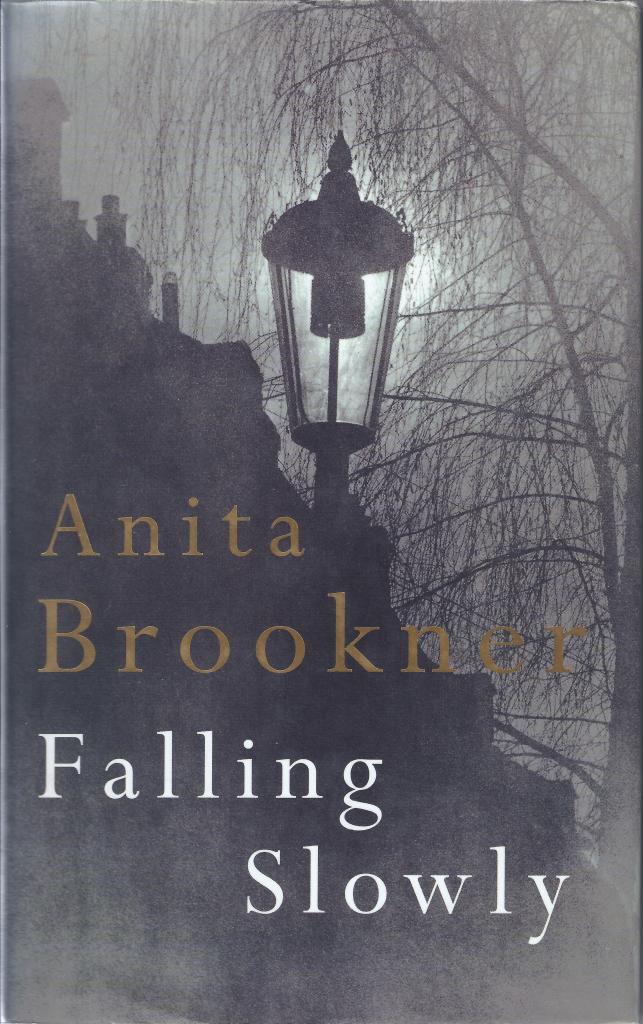
If you said “falling slowly” to me I would be inclined to think of someone falling in love. In Falling Slowly we do indeed see Miriam Sharpe fall in love, not once, but twice (maybe), but I’m no so sure it was all that slowly and I’m even less sure the title refers to falling in love. I’m more inclined to believe it’s about falling into a deep, comfortable, numbing, rut that leads to nowhere but death. Excited? By all means read on.

As I have worked my way through re-reading of Brookner’s novels, I have found more going on in her novels than I perceived the first time. And I have gotten away from thinking of her output as a monolith of quietly and comfortably tragic people just waiting to die. But then along comes Falling Slowly, a poster child for the Brooknerian stereotype. Those who don’t know my love for Brookner, might think this declaration is tantamount to criticism. Far from of it. I love every little thing about the way Brookner dives deep into exploring loneliness and resignation making them feel like cozy, warm, blankets. Sure, blankets that will slowly snuff the life right out of you, but cozy nonetheless.

At its heart, Falling Slowly seems to be about Miriam finding out what being in love really feels like. Unlike other relationships in her life (like her short-lived marriage) there isn’t anything safe or sure about being in love. Miriam falls in love with Simon, but it seemed kind of fast to me. And after that she appears to fall in love with Tom more slowly, but does she? And is that what all of this is about anyway? No, as I mentioned earlier, I think Falling Slowly is about falling slowly into acceptance of one’s fate. As is typical with Brookner, there seem to be many opportunities for her characters to alter their fates, but as I get older I see more and more how fate is not something we can see at close range. It creeps up on us even when we think we might be avoiding it. It’s like the proverbial (and apocryphal) frog calmly getting boiled to death. We see it with Miriam’s mother who accepts her fate once she is moved into a nursing home. We see it in Beatrice who accepts her slide into death after she stops performing professionally. We see it in Max Gruber who seeks to slide into his fate in a way that would be amenable to his wishes, but in the end ends up sliding into a country apart from the one he imagined. And of course we see it in Miriam herself.

After a trip short trip to Paris that was cut even shorter than expected (this seems to happen a lot in Brookner, trips to Paris to work out some sort of emotional cobweb are almost always cut short) Miriam’s “rebirth” is astonishing in its moribundity (this needs to be a word):

At Waterloo, her usual neutral smile in place, the usual courtesies offered and accepted, the usual immaculate appearance adjusted, she took her first steps into a world in which she perceived the possibility of being denied essential information, a world in which silence was commonplace, and absence a forgone conclusion.

Have you ever felt that way after a mini-break? And this is with almost 90 pages to go.

I came across one line that made me do a bit of a double take. Almost like an alien popping out very briefly from Brookner’s immaculate, polite mind only to retreat as quickly as it appeared. After spying her love object in a restaurant with another woman Miriam describes her:

The girl, meek, her eyes cast down, like a heifer, was beautiful.

For those who don’t need to be convinced to pick up a Brookner but might want to differentiate between her two dozen novels, I suppose I could point out that Miriam is a translator of French books who spends her work day at the London Library. And central to the story is her sister Beatrice who is/was a classical piano accompanist. Not to mention a few fabulous descriptions of paintings, masterfully done by art historian Brookner. So if that is your bag, then this is your bag.