[Number 21 in my chronological re-read of all of Anita Brookner’s 24 novels.]
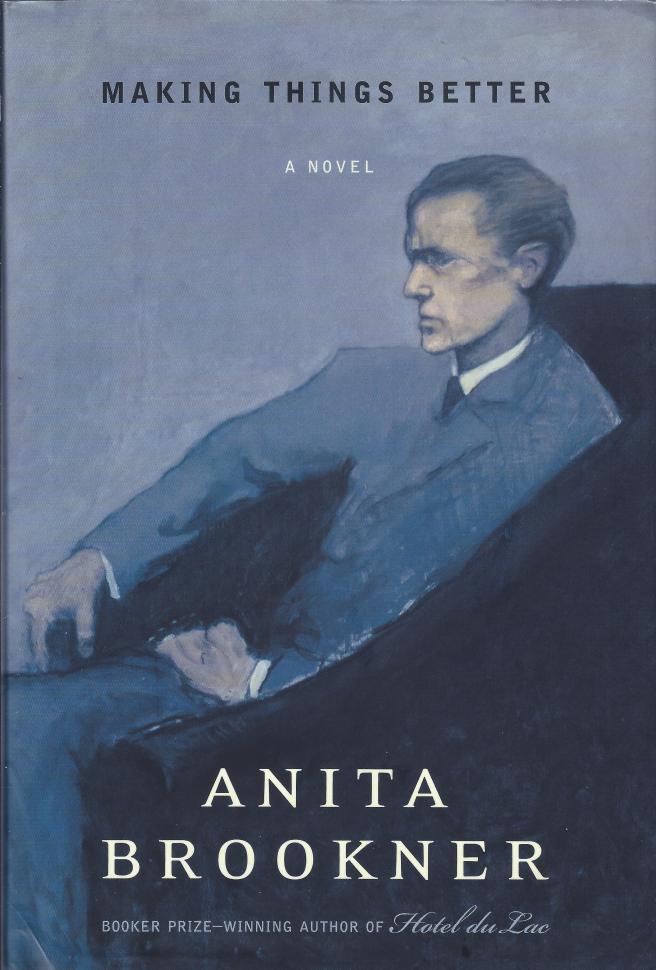
Julius Herz has spent his life trying to make things better. In big ways for his parents and his brother, and in smaller ways for most everyone else he bumps into. It’s easy to see why Brookner (or her publisher) decided on this as the U.S. title. Indeed the title pops up multiple times in the text. It is a little harder to see why the U.K. title (and presumably the original title) is The Next Big Thing. There are a few next big things here and there, but in true Brookner style they don’t seem that big, and in even truer Brookner style, most of them don’t amount to anything, even on the few occasions where Herz actually goes through with them. There is certainly the next big thing that plays out in the final chapter of the book, but it doesn’t necessarily wash away all the decades of making things better.
Refugees of Nazi Germany, Julius, his brother Freddy and their parents are installed in a flat in Hilltop Road by Ostrovski a connection of a friend of a relative. Ostrovski also gives Herz’s father a job in a record shop he owns and later also employs Herz. After they relocate to London, brother Freddy suffers an obliquely described breakdown that relegates him to lead an off-stage existence in a sanitorium and later hospice in Brighton. Freddy’s ultimately thwarted, but prodigious musical talent, and their parent’s focus on it stand in contrast to their general ingratitude toward, and neglect of Herz. It is true that they pretty much disown Freddy as soon as it is clear he won’t be pursuing the musical career they had driven him to, but throughout one has the distinct impression that what he was, and could have been, remained more important to them than any of the countless daily acts of support that Herz provides.
Forced into a financially comfortable retirement by Ostrovski’s decision to sell off Herz’s flat and the record shop where Herz worked his entire adult life, Herz’s present day life is a dull succession of reflection and inertia. There is his first love (and first cousin) Fanny Bauer to think of as well as his ex-wife Josie, but not much else. His boredom and loneliness result in overtures of various consequence to Fanny and Josie as well as a rather tragic and wholly misjudged overture to a young neighbor. In fact, it might be that indiscretion with the neighbor Sophie that startles Herz into more appropriate action with Fanny and Josie.
As with all Brookner novels, the lack of movement on the surface belies more themes than any book club could handle in one session. There is an elision of time that contracts and expands the temporal distance between events and conditions described. How long did they live on Hilltop Road before moving into the much smaller flat above the shop? How long did Herz continue to work in the shop after his parents died? How much time was there in between his parent’s death and Freddy’s death? Exact details aren’t needed, but the lack of clarity says something about Herz’s recollections and probably his life itself.
Then there is all the reading between the lines about Herz’s youth. Questions about Freddy’s breakdown and Ostrovski’s role. Themes dealing with outsider/refugee status, the post-war Jewish diaspora, socio-economic caste and their lives above the store. Indeed in The Next Big Thing Brookner uses about 70 more pages than she typically does. I’ve read it twice now and have gone back and re-read passages while compiling the place names for Brookner’s London, and am struck by the depths left to plumb. Not the least of these is the next big thing(s) that round out the book.

 Brookner Place