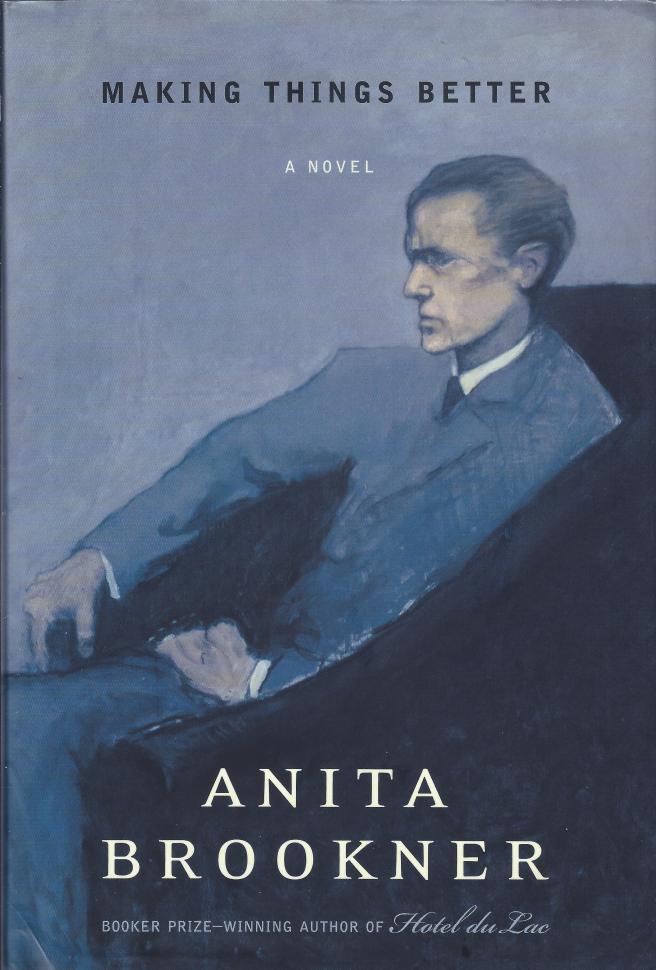
Review: The Next Big Thing / Making Things Better

[Number 21 in my chronological re-read of all of Anita Brookner’s 24 novels.]

Julius Herz has spent his life trying to make things better. In big ways for his parents and his brother, and in smaller ways for most everyone else he bumps into. It’s easy to see why Brookner (or her publisher) decided on this as the U.S. title. Indeed the title pops up multiple times in the text. It is a little harder to see why the U.K. title (and presumably the original title) is The Next Big Thing. There are a few next big things here and there, but in true Brookner style they don’t seem that big, and in even truer Brookner style, most of them don’t amount to anything, even on the few occasions where Herz actually goes through with them. There is certainly the next big thing that plays out in the final chapter of the book, but it doesn’t necessarily wash away all the decades of making things better.
Refugees of Nazi Germany, Julius, his brother Freddy and their parents are installed in a flat in Hilltop Road by Ostrovski a connection of a friend of a relative. Ostrovski also gives Herz’s father a job in a record shop he owns and later also employs Herz. After they relocate to London, brother Freddy suffers an obliquely described breakdown that relegates him to lead an off-stage existence in a sanitorium and later hospice in Brighton. Freddy’s ultimately thwarted, but prodigious musical talent, and their parent’s focus on it stand in contrast to their general ingratitude toward, and neglect of Herz. It is true that they pretty much disown Freddy as soon as it is clear he won’t be pursuing the musical career they had driven him to, but throughout one has the distinct impression that what he was, and could have been, remained more important to them than any of the countless daily acts of support that Herz provides.

Forced into a financially comfortable retirement by Ostrovski’s decision to sell off Herz’s flat and the record shop where Herz worked his entire adult life, Herz’s present day life is a dull succession of reflection and inertia. There is his first love (and first cousin) Fanny Bauer to think of as well as his ex-wife Josie, but not much else. His boredom and loneliness result in overtures of various consequence to Fanny and Josie as well as a rather tragic and wholly misjudged overture to a young neighbor. In fact, it might be that indiscretion with the neighbor Sophie that startles Herz into more appropriate action with Fanny and Josie.

As with all Brookner novels, the lack of movement on the surface belies more themes than any book club could handle in one session. There is an elision of time that contracts and expands the temporal distance between events and conditions described. How long did they live on Hilltop Road before moving into the much smaller flat above the shop? How long did Herz continue to work in the shop after his parents died? How much time was there in between his parent’s death and Freddy’s death? Exact details aren’t needed, but the lack of clarity says something about Herz’s recollections and probably his life itself.

Then there is all the reading between the lines about Herz’s youth. Questions about Freddy’s breakdown and Ostrovski’s role. Themes dealing with outsider/refugee status, the post-war Jewish diaspora, socio-economic caste and their lives above the store. Indeed in The Next Big Thing Brookner uses about 70 more pages than she typically does. I’ve read it twice now and have gone back and re-read passages while compiling the place names for Brookner’s London, and am struck by the depths left to plumb. Not the least of these is the next big thing(s) that round out the book.

Review: The Bay of Angels

[I’m up to number 20 in my chronological re-read of all of Anita Brookner’s 24 novels.]

I often don’t like reading the synopsis of a novel prior to reading it. I’m always afraid of it giving too much away. Kind of like a movie trailer that packs so much into three minutes you begin to think they have given away the entire movie. I’m not sure why I feel this way about blurbs on books. As soon as I begin to read the book itself, it is rare that I remember anything about the blurb. Everything that happens is about as surprising to me as if I hadn’t read any blurb. And so with The Bay of Angels, I didn’t read the front jacket flap until I sat down to write this review. It equates Zoë Cunningham’s outlook on life with her childhood fascination with fairy tales. This rang no bells for me. Fairy tales? When does that come up?

And then I open the book and read the opening line…keep in mind, by this point I have read the novel twice–although the first time was 19 years ago…

I read the Blue Fairy Book, the Yellow Fairy Book, and the stories of Hans Anderson, the Brothers Grimm, and Charles Perrault.

Not entirely sure how I forgot that set up, especially since Brookner goes on for another page a half describing how Zoë’s immersion in fairy tales set her up to expect some sort of outside force to be the sole mechanism for making any sort of change to life. She sees everything through that lens, at least as it applies to her own life and that of her unhappy mother.

One simply had to exist, in a state of dreamy indirection, for the plot to work itself out. This was a moral obligation on the part of the plot: there would be no place for calculation, for scheming, for the sort of behavior I was to observe in the few people we knew and which I found menacing.

And so it is that Zoë accepts the solitary, unhappy life of her widowed mother, Anne, as prelude to something better, and sees her own life as something in which she has no real role other than to wait for something to happen. It isn’t long before Anne’s deus ex machina arrives in the form of a second husband, Simon, who whisks her off to sunny Nice to continue their lives in his flat there. Simon also proves to be Zoë’s knight in shining armor, rewarding her own passivity with the gift of a flat ensuring her stability in London while he and Anne begin their new lives together in Nice.

Zoë bumps along with her life in London and boyfriend Adam, the two of them travelling the Continent from time to time during the off season, staying with Anne and Simon on their way through France. After what turns out to be a rather unsuccessful visit, Zoë and Adam slowly make their way back to London where she takes up freelance editing, and Anne and Simon continue their lives in southern France. That is, until another deus ex machina upends Anne’s life and she ends up in private clinic under sedation.

It is in that clinic where Brookner’s world view is amplified in a way that is both beguiling and confusing to a modern reader. I say ‘modern reader’ as if The Bay of Angels were some relic of the past. In fact, published in 2001, the novel is only 20 years old, but like most of Brookner’s fiction, can seem of another time and dimension. So often in Brookner, one has the feeling she is a decade or two out of step. In terms of gender and sexual mores as well as the trappings of life. In Brookner’s novels everyone has a solicitor, or at the very least an accountant, who takes care of all manner of leases, wills, annuities, and other legal and financial instruments that the vast majority of people neither have, nor even think of. (It’s like Trollope without the vicars.) It’s also a world of Harley Street specialists and private clinics where tablets, and less often, injections, play an outsized role and diagnostic testing consists of nothing more than a stethoscope. And so it is in this private clinic in Nice where Anne is installed to recover from an emotional shock. We learn nothing of her diagnosis, we just know that her recovery is going to take some time, involves a fair amount of drugs, and requires extremely limited interaction from Zoë.

Perhaps there is a world of private clinics like this that exist for the worried well, who can afford it, where they can give up all worry and control to a cadre of healthcare staff. Indeed, in some ways it reminded me of the clinic in the south of Spain that plays a central role in Deborah Levy’s novel Hot Milk, in which a daughter’s story plays out while her mother receives highly personalized care for some extended, unexplained malady. Or perhaps it is just a way for Brookner to cast a fairy tale spell on a character.

With her mother in the clinic, Zoë takes a room in Nice to be close at hand. Without a clear indication of her mother’s outcome and uncertainty about her own outcome, a restlessness takes over as Zoë yearns for stimulation. Noise, activity, human interaction. As her mother’s circumstances only allow for the hand of fate, Zoë seems less content to wait for fate to direct her own life. She realizes in a slow, subtle, Brooknerian way, that her fate cannot be left to some fairy tale outcome, that her existence, her happiness, require exercising some kind of will. I don’t think the lesson is as facile as the realization that passive acceptance is in itself not passive, but rather a realization that each of those fairy tale characters had an untold backstory that guided their fates. I am, perhaps, imposing too much of myself on Brookner’s intent, but even up to the last two pages Brookner seems to be of two minds. On the one hand Zoë is prepared to take whatever life throws at her and accepts that whatever her future is, her story isn’t over and whatever unfolds unfolds. On the other hand, and to my mind, more importantly, she also realizes that a thousand small compromises need to be made if one is to have a shot at happiness. Small movements one direction or another can tempt fate one way or the other and Zoë has decided, however passively, that her fate is to be happy rather than tragic.

…I am reminded once again that I have been fortunate, and that my continued good fortune depends on tact, on discretion, on clearsightedness. These qualities are not beyond me. I am not without resource, should it become necessary. For the moment all is well. The future is, in sense, taken care of: it is in another’s hands. And in mine, perhaps, but I decide not to think ahead.