Guest Review: Leaving Home

[The following review of Leaving Home was written by Tracey at A Book Sanctuary.]

I chose Leaving Home, the 23rd of her 24 novels because my library had a copy and also as it is partially set in Paris, I thought it would fit in well with reading for Paris in July.

This is my third attempt at a book by Anita Brookner. The first was Hotel Du Lac which although slim I started but never finished. It was a couple of years ago now and I remember finding it just ok before something more appealing came along and I never went back to it. Not a good start considering Hotel Du Lac is her most praised novel having won the Booker Prize in 1984.

Next up was Strangers, Brookner’s latest novel published in 2009. I thought it was beautifully written but a bit melancholy for me.

So I was hoping with Leaving Home it would be third time lucky.

Leaving Home is a very intimate slice of life type story told in the first person by Emma Roberts, an introverted young woman who lives at home in London with her widowed mother. Everything about their lives is carefully controlled and predictable. Their roles are unspoken yet firmly fixed, their interactions superficial and routine, nothing out of the ordinary happens. Emma is a sensitive and insightful woman, if overly reflective and introspective, and she is acutely aware that she is living her life this way but thinks she is the sort of person for whom nothing riskier or more exciting will be possible. She is by her own admission the sort of person people take advantage of and whose life choices to date have been made by other people. In short, Emma Roberts does what other people want Emma Roberts to do.

The tiny part of her that craves something more takes her to Paris to study the seventeeth century gardens in the city, of which she plans to write a book. She takes a modest room in a hotel and despite her discomfort with this unfamiliar set up, she branches out a little, making a friend of sorts in Francoise, a flamboyant librarian and being accepted into Franoices’ beautiful family home and by her rather formidable mother Mme Desnoyers.

Emma finds herself blossoming in Paris but her upbringing and the comfort of what she knows exert a strong pull – she makes several trips between Paris and London, dealing with the deteriorating health of both the mothers, trying to decipher the relationships she is building in each city and her and other people’s expectations.

As her story evolves, she becomes stronger, more confident and more accepting of herself and her life.
Leaving Home has a timeless feel to it, it could have been set any time within the past 40 years or so and there is actually only one brief reference to the time period in the book.

With both Strangers and Leaving Home, I felt almost honoured in a way to be privy to the most private thoughts of the main characters, to share their fears and insecurities which touch on the purpose of our lives, such a personal and fundamental thing for us all.

Once again though I finished this book feeling it was all a bit gloomy.

So was it third time lucky? Perhaps it was – I suspect this won’t be the last of Anita Brookner’s books I read but I can’t quite put my finger on why! This reminds me of the way I feel about Penelope Fitzgerald, something hasn’t totally clicked but I keep going back for more….

Now I can’t wait to visit some more seasoned readers of Anita Brookner and see what they have to say about the books they read today.

Happy birthday Anita Brookner.

Guest Review: The Rules of Engagement

[The following review was written by Emily at Telecommuter Talk.]

Thanks to Thomas over at [Hogglestock], I am now a huge Anita Brookner fan. Today is Anita Brookner’s 83rd birthday, and in honor of her, he has declared it to be International Anita Brookner Day (IABD). He challenged all of us to read one book by Brookner and to post on it today. He also offered some of her books up in a drawing, and I was a lucky winner of The Rules of Engagement. Easy decision, then, as to what I’d read for the challenge.

I had no idea what to expect, but Thomas and I seem to have quite similar tastes in books a good deal of the time (he’s a huge Persephone and Virago fan, like I am), so I came to this book thinking I’d probably like it. What I didn’t expect was that I’d sit down one afternoon just to read the first 20 or so pages to see what it was like and still be sitting there 130 pages later, all other plans for the afternoon forgotten. In fact, the only reason I put it down at that point was that I was starving and thought it might be a good idea to get a little food in my stomach.

Brookner is the sort of mesmerizing writer I love, one who pulls you into a story gently, so you don’t realize what a firm grip she has on you until you are suddenly aware that there’s no getting away. This book was a real page-turner, although not in the sense that expression is typically used. It wasn’t action-packed or nail-bitingly suspenseful. It just was so incredibly real, and she made you care so much about her characters that you really wanted to know what was going to happen.

Back when I was in my mid-twenties, I remember sadly coming to the conclusion that making friends as an adult was so difficult, that it was very hard to make the sort of friends I’d had in school and college. When you’re an adult, you just don’t have hours and hours to talk on the phone and to stay up all night solving all the world’s problems together. People are more guarded as adults, more afraid of betrayal. It’s probably because we’ve learned from past mistakes and know that not everyone we consider a friend really is one. I remember thinking how rare it was to find someone with whom I clicked the way I seemed to do with people in college.

When Facebook first became all the rage, I was fascinated by the idea of re-connecting with some of the people I’d known in grade school and high school. I wondered if we could pick up where we’d left off after so many years. What I discovered, is that I couldn’t. We’ve all led completely different lives, and it was soon clear to me that we just didn’t have that much in common after so many years apart. The fact that we’d gone to school together, had slumber parties with each other, and enjoyed roller skating at the rink on Saturday nights meant nothing at this point in our lives. Maybe, it would, if I didn’t live too far away from any of them to get together on any sort of regular basis, to see if we had more in common, but I didn’t. Sad to say, I don’t pay that much attention to their FB pages anymore.

I’m reminded of that line from The Big Chill, that William Hurt says (to Kevin Klein, I think. It’s been quite a while since I’ve seen that movie), something to the effect of, “We knew each other for a short period a long time ago. You don’t know anything about me now.” It was a line that appalled me when I saw the movie for the first time, in the midst of my college career, convinced my friends and I would be as close as we all were forever. I now understand it much better than I did back then.

Brookner’s book is all about such friendships. Elizabeth and Betsy (interesting that they both have the same name. Elizabeth is definitely the sort who would never have shortened it to the more playful “Betsy,” and Betsy is the sort who would) are school friends, the kind who seem to have been drawn to each other, basically, because they didn’t really have any other friends. They meet and become friends in the 1950s and both come of age in the sixties, a little shocked and taken by surprise by such things as the feminist movement. Elizabeth retreats in “good girl” fashion, marrying as her parents expect her to do. The man she marries is much older, and she quickly finds herself in the role of bored housewife. Betsy traipses off to Europe and falls in love with a Communist.
Later, they find each other again, two completely different women who’ve chosen very different paths in life, struggling to remain friends because, well, they’ve been friends for so long. They do have something in common, though, which is a desire to escape the lives they find themselves living. Although Elizabeth seems like she would be the more naïve of the two, she (who narrates the story) actually seems to be far more perceptive than Betsy, far more aware of the fact that they’re trying to escape their lives. Betsy still seems to have the heart of a school girl: eager to be loved, eager to love, wanting others to like her. Nonetheless, Elizabeth isn’t as immune to her emotions as she would like us to believe, and, just as it seemed in their schoolgirls days, these two don’t really seem to have any other friends but each other.

I won’t say anymore about the plot, because, really, half the fun of the book is not knowing what’s going to happen. I will say, though, that one of the aspects of this book I really enjoyed was how it made me think about the women’s movement when it was young and the effects it had on women who were not quite sure what to do with it. Elizabeth mentions “feminists” time and again, and she seems not quite sure what to make of the new roles being defined for women, while also seeming to feel she’s missed out on something by taking a more traditional path. I’ve never thought that much about how hard it must have been for women who were raised with certain expectations and in certain social classes to be given the freedom they so deserved. Elizabeth’s reaction, I’m quite convinced, although secretive and not admirable, was probably quite common. Broken hearts were also, I’m sure, quite common.

I’m certainly eager to read more Brookner now. I’m in luck: she’s written so much. Meanwhile, I’d love to introduce her to someone else, so I’m going to pass on this book that was given to me. If you’ve never read her and would like to give her a try, please leave a comment. I will draw a name on July 21st and send it on to the lucky winner.

Guest Review: The Rules of Engagement

[Martine of Silencing the Bell didn’t exactly have a love affair with The Rules of Engagement.]

I went to Chorlton library and found Rules of Engagement, it was the only one of her books they had. It turns out I should have popped down to Didsbury, where they seem to have a much better choice of Anita Brookner novels.

I am not sure that they will want me to join in when I say how bored I was by this book. I mean there is introspection and there is introspection … and this book takes it all to a whole new level (or is that depth?) I mean no wonder this woman spent so much time worrying about her motivation and her ‘relationships’ and her emotional reactions and what people thought … because she had *absolutely* nothing else in her life. And the real trouble with all this introspection was that the woman was so devoid of personality that she never thought anything interesting. She never once said anything meaningful to anyone or had a real conversation about anything or really showed any interest in another human being or interest in anything beyond her own thoughts (ok she read a few books, but a very limited selection and only thought of them in terms of how they reflected back her own thinking or opinions.) She is never really happy, sometimes contented, never has a strong sense of attachment to another person, even her supposed affection for her lover is couched in oblique language. I am sorry because, on reflection, I feel like my intense dislike of the woman and her life distracted me from the writing, which was plainly very effective since the book had such a strong impact on me and created such a powerful reaction. The book was the story of a wasted life.

Now my mood changed to one of weariness and incipient revolt. I played my wifely part adequately, and yet I could see it for what it was: a sham. And it was not only my married life that was a sham; my other life too did not, could not, bear active scrutiny. I saw the point of those grim days in Paris. They had been the means of preparing me for a life lived according to my own rules, rather than rules imposed on me by other people. I had had a glimpse of the freedom available to the purely selfish, though that freedom could be limited by desire. Once again I wanted to roam the streets unobserved, my thoughts confined to myself rather than anticipating another’s movements, another’s wishes. I wanted everyone to die and leave me alone. I particularly wanted Edmund to die, for I knew that without him I should be myself again and not the person I had becomes once I had chosen him, or been chosen by him.(p.60)

The whole book just goes round in circles as she rethinks herself: her friendship with Betsy, which is frequently broken beyond repair and then reestablished, her marriage, tedious to a fault but with Digby repeatedly referred to as ‘honourable’, her affair with Edmund, acknowledged as shallow and physical but to which she ascribes deep feeling, she recognises she should ‘do’ something with her life but utterly fails to act. Years go by, taking her from a newly married twenty-something to being middle aged, in which *nothing happens* apart from a couple of boring people coming round for dinner.

I wanted to scream in frustration, I wanted to give her a good hard slap. It’s as if she never moved anywhere from the young woman she was bought up to be, learned nothing from her experiences, had such narrow expectations of life and no imagination. And as I often do I found myself clinging to the hope that it was all leading somewhere, an epiphany, anticipating some kind of denouement that never came, it just kind of dribbled to a halt at the end. I plodded through it, just as I am struggling with this review, because I wanted to contribute to the IABD. I do not feel inspired to read any of her other books.

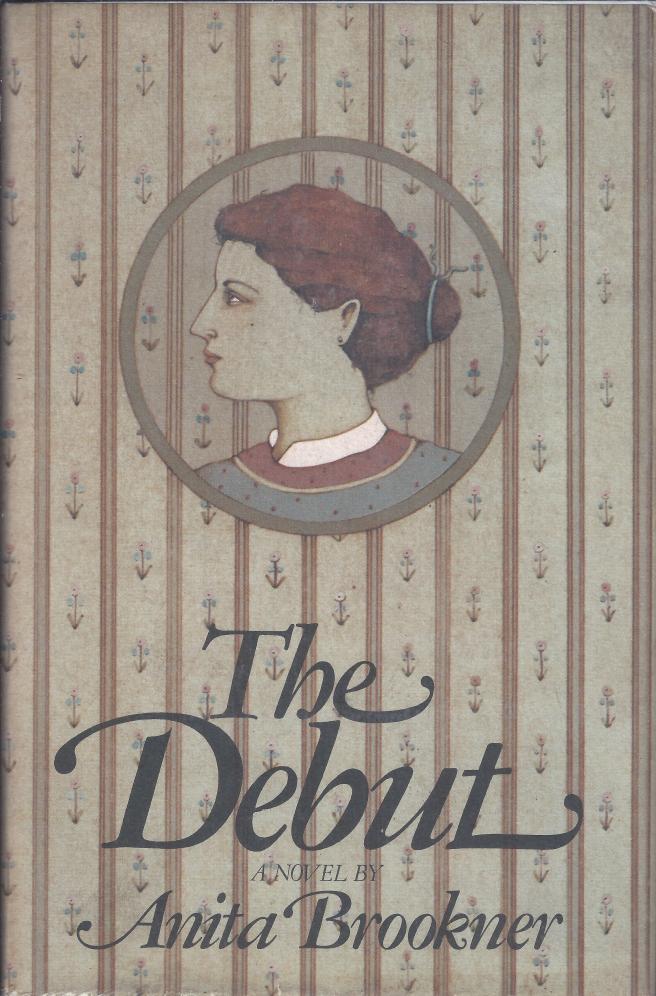
Review: The Debut/A Start in Life

You probably know by now that I have already read all of Brookner’s 24 novels, having finished up the last two last year. So now I get to go back and read them all again, except this time I am going to read them in chronological order. I was tempted for a bit to read a few for IABD that others haven’t reviewed so I could help fill in some of the gaps in the reviews. But my OCD kicked in and insisted I follow chron order.

I don’t do much re-reading so it is a bit of a novel (ha) experience for me to go back and start from the beginning. If there is any author whose work fares well, perhaps even better, on a second read, I am finding that Anita Brookner is that author. Perhaps the most difficult part of reviewing a re-read is that it kind of requires me to dig a little deeper than I normally do in my reviews. But that could turn out to be a hot mess. Here it goes.

By now it is almost cliche in a review of The Debut (A Start in Life outside the U.S.) to quote the opening sentence:

Dr. Weiss, at forty, knew that her life had been ruined by literature.

In my humble opinion, one of the great opening lines of the 20th century. (Yet in a way, it isn’t very 20th century in sentiment, is it?) Slightly less often, reviews of The Debut go on to quote what comes after the opening line:

In her toughtful and academic way, she put it down to her faulty moral education, which dictated, through the conflicting, but in this one instance, united agencies of her mother and father, that she ponder the careers of Anna Karenina and Emma Bovary, but that she emulate those of David Copperfield and Little Dorritt.

But then where do I go from there? Perhaps say something trite about the fact that Brookner’s work is highly literate and that she is nothing if not a booklovers novelist. Done and done.

Actress mother, bookseller father far too into their own lives to bother much with their only child. Old world grandmother does her best to make a pleasant home life for Ruth, but really what kind of life is it for a child? Immature, self-involved, vain parents and an aging grandmother. No wonder Ruth turns to books for sustenance and life lessons. She says of her first encounters with Dickens that “The moral universe was unveiled.” With books standing in loco parentis it is no wonder that Ruth looks to books for comfort when her grandmother passes away…literally:

For once she learned cunning. “They all talk about you at school,” she said carefully. “they ask me lots of questions. They still talk about you in Lady Windermere’s Fan. And you’ve never been there. You or Daddy. I think you should come once. These things make a difference.

And then reverting back to girlhood:

Cunning deserted her. “And it is my future we’re talking about.”

And so they go to school and so then does Ruth go to university. But even in that her mother’s selfishness wins out. Although she shows little interest in Ruth’s life, her mother insists that she not even try for Oxford or Cambridge because she wants her close at hand.

Like so many socially awkward people, Ruth’s world and personality open up at university. She still lives a life of books–more so than ever–but makes friends, moves to Paris to study, has romantic assignations, and seems to be looking forward to life in Paris. But it isn’t long before her parent’s to wield their selfish heads to recall her to London to keep an eye on ailing mother so that philandering father can continue his affair untroubled by who is taking care of his wife. Even her marriage that ultimately results out of her return home doesn’t quite put her on a trajectory as fulfilling as the…

God, I am beginning to bore myself. That doesn’t bode well for you dear reader. This review sounds half-baked. I am not sure what I am getting at. Part of the problem for an amateur like myself is that I want to say something as clever as Anita Brookner’s prose. Before I started re-reading her novels–although I loved them–I felt the need to qualify my love. I would warn people that not much happens. That they are depressing. That they all kind of blend together. But you know what? My re-reading experience thus far (I have also re-read her second novel Providence), has really proven to me that my enthusiasm for Brookner doesn’t require qualifiers. Sure, they won’t be for everyone, but her books are far too good and her writing far too deep and illuminating for me to be apologizing for her work. They really are brilliant. And this my friends is why I suck at reviewing them properly. How can anyone try and describe what Brookner has distilled into 192 crystalline, almost poetic, pages of human emotion?  I certainly can’t.

P.S. I think the original title A Start in Life is far better than the U.S. title. A debut suggests a well prepared for entrance into the world. Whereas Ruth just seems to slide into things with little help from anyone and with no fanfare. Plus a start in life can refer to many stages in her life: her formative years when she got her actual start in life; her university life in which she manages to get a start in her professional life; getting started in what the reader hopes will be her life in Paris; and finally as she gets started in the non-Paris life that will no doubt see her through to the end.

Six Degrees of Anita Bacon

In the lead up to International Anita Brookner Day, I was making all kinds of tenuous connections between my posts and Anita Brookner. After reading Peta’s much deeper analysis of connections between Brideshead Revisited and Anita Brookner, I  began thinking about the Six Degrees of Kevin Bacon game.

Are you familiar with the Six Degrees of Kevin Bacon game? To play, all you have to do is link any celebrity to Kevin Bacon within six degrees. I read an article years ago in The New Yorker that posited that this game works with Kevin Bacon because he has been in such a variety of projects and had not been typecast. The article stated that someone who made many more films and was far more famous, like John Wayne, won’t necessarily fare as well in the Six Degrees game because their were work was more specialized.

So I thought how many degrees of separation between Kevin Bacon and Anita Brookner. Using Diana Quick from the Brideshead post as a possible starting point, it was far easier than I thought it would  be to connect these two dots. I bet there are other connections as well.

Kevin Bacon


Was in Where the Truth Lies with Colin Firth


Who was in (the sappy) Love Actually with Bill Nighy


Who was in a 27-year relationship with Diana Quick


Who voiced an audiobook of Anita Brookner’s Undue Influence


 That’s only 5 degrees of separation. Can you do better?


Guest Review: The Rules of Engagement

[This review of The Rules of  Engagement was written by Jess at Park Benches & Bookends.]

The Rules of Engagement is my first Brookner read and I purposely did not read any other reviews or anything about the author so I could read with a completely open mind.

The book is narrated by Elizabeth, a woman born into privilege but a little too late to be part of the woman’s new sexual and liberal freedoms during the decades following the sixties (a fact the reader is constantly reminded of). Elizabeth instead goes down a very traditional 1950s path. She marries a man much older than herself and settles into a moderately happy but passionless marriage, passion is supplied to her from her married lover. When her husband dies she lives a solitude life, never working, never doing anything really aside from going for long walks around London and keeping an eye on her oldest friend Betsy.

Betsy in contrast first lives in Paris involving herself in a passionate affair for many years but when she eventually returns to London her decisions shake up and impact Elizabeth’s life.

Not a huge amount actually happens in this book, all the exciting stuff is going on in Betsy’s life of which we only hear a small portion of from Elizabeth. The writing has a melancholic feel to it as Elizabeth ponders over her situation and the awful people in her life. At first I liked the book as I’m quite happy to read books with little plot. The beginnings of Elizabeth’s marriage along with her bore of a husband lead me to think it was all going to be a bit Madame Bovary and the sad demise of Betsy going from sparkly, innocent, young women in Paris to being sucked into the dreary life of Elizabeth’s London was well done.

But by the end I got very frustrated with Elizabeth. Elizabeth is an observer who does not get involved with anything. Elizabeth ponders over going aboard, taking an evening class, getting a job but never actually even coming close to doing these things. Her excuse is always the ‘well I was born too late as a women to do anything with my life’ this might work over a period of small time but not over several decades. Just like Elizabeth’s life, it all became very dull.

In conclusion I can only think that this novel would have worked much better as a novella which the novel would be if Elizabeth’s repetitive ramblings were removed.

Annabel from Gaskella has also recently posted a review of this book in which she says “The Rules of Engagement is one for Brookner completists, first time readers should probably start elsewhere” I think I’ll take her advice and read another Brookner novel before making my mind up completely.

Guest Review: Leaving Home

[I’ve lost count of the number of Australians participating in IABD. This time Brisbane. This review of Leaving Home was written by Alex at Luuvie’s Musings.]

The great thing about writing book reviews is it makes you think.  The great thing about reading Anita Brookner is she really makes you think…and then want to talk to someone about what you’ve read.

Thomas at [Hogglestock] and Simon of Savidge Reads are co-hosting International Anita Brookner Day this Saturday 16 July.  They remind us that “thirty years ago…Anita Brookner had her first novel, the aptly titled A Start in Life (or The Debut in the U.S.) published at the tender age of 53.”  They’re encouraging everyone to read and review her work.

Well, thirty years ago I was twenty and probably about to read Anita Brookner for the first time…I had in fact just left home.  I haven’t read Anita Brookner for yonks and welcomed the return.  Leaving Home is one of Brookner’s more recent titles and how curious and spooky that I should choose it from the library shelf after all these years.

Thomas is quite correct.  There really is no excuse not to read an Anita Brookner – they are mostly under 200 pages and a relatively easy read.  I polished off Leaving Home in less than a week but was left with a slightly maudlin feeling – or one of deep melancholy.  Don’t get me wrong – I tend to lean towards the melancholy in terms of taste, but this time I was feeling a bit impatient and disaffected with it.  “Where’s the drama?” I wanted to scream – reminiscent of my colleagues’ John and Billy – who won’t mind being called old (in the nicest sense of the word)friends/screenwriting lecturers from AFTRS days.

Peta Mayer says there are ten things you should expect from an Anita Brookner novel – my review is probably a reflection of  Point Number 5 – Expect to see a reflection of yourself, not necessarily in the best light!

I was forced to reflect on my feelings…something which I think we should do more of….really critically analyse our responses to things.  Why was I so disaffected?  What is great writing after all?  Had perhaps Anita Brookner drawn a very accurate depiction of a character that was perhaps just a little too close to the bone for me?  What were my thoughts and feelings when I made the momentous decision to leave home? What was I hoping to achieve?  What had I made of my life?  Had I really rebelled or had I conformed in the end?  And was that a character fault or the way of all things?

My memory of Anita Brookner’s work is that she really hones in on one character’s experience.  It becomes at times somewhat claustrophobic – particularly if the characters don’t do much or are great thinkers…which is the case in this instance.  Our main character in Leaving Home is Emma. Emma is a writer reflecting on her journey to this point.  The novel opens with her remembering a dream from her youth (there’s another one of Peta’s points no doubt – Point Number 9 – Freud).  The dream points to the necessity of Emma leaving home in order to carve out, she hopes, a less sad and lonely existence than that of her widowed mother.  

Emma is the epitome of Englishness.  What do I mean by that?  Well she is unfailingly polite, restrained, tactful, discrete.  Emma writes thank you letters.  Need I say more?  I do not think Brookner chose her name lightly – Jane Austen’s Emma must be one of the most famous character’s in English literature – and yet Brookner’s Emma is, I think, very different.  Emma is anxious to leave home gracefully.

It would have to be managed, and managed, if possible, without disloyalty, more or less invisibly, above all in good faith.

Emma is an only child and a daughter – which can bring the double handicap of being expected to be very good – and whilst she cares genuinely for her mother’s feelings, she wrestles with the expectation of her uncle to be her mother’s supporter and provider.  Emma in short needs to rebel.  But, dear reader, Emma is English. People who queue find it hard to rebel.  She settles on studying classical garden design, is offered a scholarship in France and away she goes, in search of “another source of authority, another agent of influence.”  Where better to learn to rebel than to ensconce herself in Paris – the very home of revolution?

We then witness Emma’s various attempts to seek out real and/or satisfying relationships both with members of the opposite sex and her own sex.  Of all the relationships, her friendship with the aptly named Francoise is the most complex and challenging.  Complex because Francoise is almost a reflection of herself but not quite.  Francoise is also an only child and a daughter.  But Francoise could almost be the French version of Jane Austen’s Emma.  Whilst not beautiful, she is certainly striking and “electric with an energy that made her presence in the library dangerously welcome.” Francoise is not a match-maker as such, but is certainly keen to see Emma “break out” and find an “amoreuse”.  Francoise only handicap is her controlling mother, who is keen to marry her off to the local prize beau – “Jean-Charles – a pale, slightly corpulent man of indeterminate age.”  The relationship is challenging because, whilst Francoise is an agent of influence and change, her authority becomes a threat to Emma’s own self-determination.

It would spoil the book if I told you too much more.  There is drama – eventually – in Leaving Home.  Brookner saves it til the very end.  It wasn’t til this passage that my heart fluttered in recognition of the Brookner of yore…”It takes a kind of genius to save one’s own life, the sort of genius that I so signally lacked.”  Now things were getting interesting!  What would happen next?

For me Brookner’s strength is her great depiction of character.  Emma is by no stretch of the imagination a conventional hero.  She says as much about herself and I don’t think it would take too much away to quote some of the novel’s last few lines…

Not everyone is born to fulfil an heroic role.  The only realistic ambition is to live in the present.  And sometimes, quite often in fact, this is more than enough to keep one busy.

What do you think?  Should we all be legends in our own lunchtime?  Is Emma a victim of her Englishness which she can never escape?  Or her cloistered upbringing?  Or her sex?  Is she a victim or a hero?  Is she Anita Brookner’s alter ego wishing she had been Simone de Beauvoir but rather glad she wasn’t?  And yes I know that is very naughty of me to say – I am being deliberately provocative, boys and girls!  Who else has read She came to Stay – funny how the heroine is called Francoise – non?  C’mon – what’s your take on this slim but tardis-like novel?

Guest Review: The Rules of Engagement

[This review of The Rules of Engagement was written by Annabel at Gaskella.]

This, her 22nd novel published in 2003, is typical Brookner with all her trademark features.  The story is about two women who meet at school but stay in touch throughout their lives.  Two girls, both called Elizabeth meet at school.  They’re both only children, Elizabeth’s parents divorced, Betsy’s died and she then lived with her aunt.  Betsy is the pretty one, and when they both spend some time in Paris, it’s Betsy that falls passionately in love; Elizabeth uses her time there coming to terms with being on her own.

Later back in England, Elizabeth marries Digby, a widower many years her senior. Theirs is a comfortable marriage – no surprises, no passion, no children either. Elizabeth is happy with this, but then she embarks on an affair with one of Digby’s friends – this relationship is one of convenience, physical needs are satisfied, but Elizabeth gradually begins to fall for Edmund.  Then Betsy comes back into her life, and things are gradually turned upside down – and Betsy’s life will continue to impact on her oldest friend’s for years to come.

If you didn’t know the book I was describing was by Brookner, from the description above, you might guess it was by Joanna Trollope say with some complicated entanglements amongst the middle classes.  But it’s not. Through the voice of Elizabeth, Brookner tells the story of an ordinary woman disappointed with life and love, ultimately content with her own company, but somehow deep down wishing she’d had the wide-eyed innocence of her friend to take her down another path.  Elizabeth meditates at length on her life, relationships and friendships, decisions taken, and things not done to keep life unruffled.

This is where I had a problem with this book.  In reality nothing much does happen – at least not to Elizabeth. It all happens to Betsy, but Elizabeth is telling the story, so we don’t know the half of it. Instead, we’re subjected to Elizabeth’s introspection about life, the universe and everything.  Characters’ actions were described in intricate detail in this book, however I felt I never really got under Elizabeth’s skin, despite having over 250 pages to get to know her.  I wish I’d been able to write more enthusiastically about this novel, for I have enjoyed the others I have read, but I feel that The Rules of Engagement is one for Brookner completists, first time readers should probably start elsewhere.  

Guest Review: Family and Friends

[Writer and blogger Jim Murdoch at The Truth About Lies has given us our first review that includes footnotes.]

I write out of a sense of powerlessness and injustice, because I felt invisible and passive.

Anita Brookner

When asked by Shusha Guppy in a 1987 interview in The Paris Review, after having first confirmed with  Brookner that she initially began writing novels to see if she could, Brookner responded:

I agree with Cioran [who said, “Writing is the creature’s revenge, and his answer to a botched Creation”], in so far as we all try to put some order into chaos. The truth I’m trying to convey is not a startling one, it is simply a peeling away of affectation. I use whatever gift I have to get behind the façade.[1]

At the time of writing Brookner was working fulltime at the Courtauld Institute of Art. Up until then all her writing had been done during her summer break, each novel taking about three or four months to complete and each completed in a single draft:

It is always the first draft. I may alter the last chapter; I may lengthen it. Only because I get very tired at the end of a book and tend to rush and go too quickly, so when I have finished it I go over the last chapter.[2]

Later she resigned and took up writing as a fulltime occupation despite the fact she clearly found the loneliness that traditionally goes with writing somewhat burdensome which is perhaps reflected in the fact her heroines follow “an inexorable progress toward further loneliness,” as she says of Kitty Maule in Providence. Not only her heroines but also in Family and Friends (with its – for her – unusually large cast), her heroes, not that there is anything especially heroic about any of the members of the Dorn family and their friends or, indeed, anything villainous.

It is an ensemble cast and all the major players are given fair time on the page. The core family consists of Sophia (generally known by the diminutive ‘Sofka’), a widow who is bringing up four children in a big house in London in the 1920s: Frederick, the eldest (“her pride and joy”), Alfred (the “sickly and favoured younger son”) – both named after kings – along with their sisters, Mireille and Babette (Mimi and Betty) – names out of “a musical comedy … The boys were to conquer, and the girls to flirt.” Impossible to read the name ‘Sofka’ and not think of Tolstoy’s wife; the fact is that the Dorns are of German extraction, not Russian.

The book opens with an unnamed narrator looking at an old photograph – Brookner has said that the book “was inspired by one of her grandmother’s wedding photos”[3]– identifying each party and saying a little something about them. What is clear is that whoever is talking now knows of all the events that lead up to the book’s final chapter:

None of these people seems to have as much right to be in the picture as Sofka does. It is as if she has given birth to the entire brood, but having done so, thinks little of them. This I know to be the case. She gazes out of the photograph, beyond the solicitations of the photographer, her eyes remote and unsmiling, as if contemplating some unique destiny. Compared with her timeless expression, her daughters’ pleading smiles already foretell their future. And those favoured sons, who clearly have their mother’s blessing, there is something there too that courts disaster.

In a poem I wrote once that I didn’t believe in destiny but I did in inevitability. Despite the fact she chooses to use the word ‘destiny’ Brookner holds a similar view regarding determinism:

I think one’s character and predisposition determine one’s fate […] I don’t believe that anyone is free. [E]xistentialism is about being a saint without God: being your own hero, without all the sanction and support of religion or society. Freedom in existentialist terms breeds anxiety, and you have to accept that anxiety as the price to pay. I think choice is a luxury most people can’t afford. I mean when you make a break for freedom you don’t necessarily find company on the way, you find loneliness. Life is a pilgrimage and if you don’t play by the rules you don’t find the Road to Damascus, you find the Crown of Thorns.[4]

There are disasters though and there are disasters. They begin with money, heirs to a successful business which Frederick is in charge of even though he has little interest in or aptitude for business; fortunately he has responsible, loyal and capable subordinates – in particular the devoted Lautner – although when he manages to hand over the reins to his little brother, even though the boy is only sixteen at the time, he is more than happy to do so. Arthur as it happens proves to be exactly the right man for the job, dedicated and resourceful, and within a few years the business is becoming an empire and no one ever has to go without.

Is it less of a disaster for an edifice to crumble than it would be for it to be destroyed overnight in, say, a huge fire? The end result will be much the same, rubble and/or ash. The Dorn family are all damaged individuals but I would be hard-pressed to point out the cataclysmic events in their lives that cause the damage. Rather it is an inevitable drift. They become the people they can be, as much as they can be these people within the confines of the society in which they grow up. What we get to witness over the 187 pages of this book is them crumble as individuals and break apart as a family. Again ‘break’ is too strong a word; its implications are of a sudden snap, a flare up, an angry interchange, and there is none of that. In fact the Dorns are so damned civilised it’s just not true.

When Alfred starts work at the firm, although doing a man’s work, he only receives a boy’s salary:

This is thought to be good for him, for, unknown to himself, Alfred has been entered on a long course of character training by those who know better than he does. In this way his character will be trained – by privation, of course – beyond those of any whose friendship he is likely to seek. His character, in fact, will be a burden to him rather than an asset. But that is the way with good characters.

A very similar phrase is used when talking about Mimi towards the end of the book:

Sometimes Mimi thinks, if only I had been bolder, had tried again sooner, had pushed my claims. But she never thought she had any claims, had only waited, and waited, had been found. And, after all, honour had been saved. She was married, she had conceived. And if the outcome has not been all that she had wished, well, that is occasionally the way with outcomes.

Alfred and Mimi are the ‘good’ kids. Betty and Frederick are too keen to give in to, to use Brookner’s own word, “ludic” impulses. It was a new word for me:

Ludic derives from Latin ludus, “play,” and is an adjective meaning “playful.” The term is used in philosophy to describe play as an act of self-definition; in literary studies, the term may apply to works written in the spirit of festival. The concept of the ludic self as fundamentally defining human beings can be expressed by the Latin phrase Homo ludens, “the human who plays” (compare Homo sapiens, the human being defined by its ability to think). – Wikipedia

Frederick (Freddy) is a charmer. He has practiced on his mother for years:

Sometimes Frederick will present his mother with one red rose. There are roses in the garden, of course, but they are the province of the gardeners. Frederick’s rose will be placed in a vase and taken up to Sofka’s bed-table. As she lies back on the square pillows that her mother gave her when she married, Sofka will look at the rose and smile.

Don’t read too much into that. Although Sofka is so civilised it’s not true she harbours a soft spot for rebels. As long as all critical roles have been filled by someone (Alfred to take care of the business and Mimi to take care of Sofka in her dotage) then she is content to see her other two children enjoy their freedom:

Betty and Frederick form a natural pair, and … [Alfred] and Mimi form another, quite different alliance. Together and apart, Mimi and Alfred stand for those stolid and perhaps little regarded virtues of loyalty and fidelity and a scrupulous attention paid to the word or promise given or received.

Betty is the first to move out. She relocates to Paris (Brookner herself lived there for three years) with plans of becoming a dancer along with Frank Cariani, the son of Mimi’s piano instructor, whom Betty has charmed away from her sister despite the fact Frank prefers Mimi and Betty knows this. Alfred and her Mimi are dispatched to bring her back but Mimi makes very little effort and Alfred none at all annoyed to find himself turning seventeen alone in a foreign country, expecting Betty to return in a week after she got this out of her system, in fact he even returns on an earlier train alone confident that all is in hand; Mimi is not so naïve, she realises her sister is lost to them. In one other regard she is just as immature as her brother: she imagines her presence in Paris might give Frank cause to pause and she might win him back but she does not. She waits for him to come to her hotel room but he does not. Betty doesn’t return home. She quickly adapts to the Bohemian lifestyle and finds “she never misses her family [although] she does occasionally think about her mother.” She soon has her eye fixed on a film career and Frank, having served his purpose, is discarded with a shrug.

What is interesting here again is how Brookner describes subsequent phone calls:

There have been telephone calls to Betty every Friday evening, and when she comes away from the telephone Sofka allows a small smile to play around her lips. Does she secretly rejoice in this outrageous daughter who has the courage to break with the conventions? Does Sofka like the bad rather than the good in her children?

Another smile. In the meantime Frederick has been besieged by the eminently viable – Brookner’s word – Evie:

…extraordinarily noisy and [with] the ability to displace any object in her vicinity. She conveys an idea of power which has nothing to do with charm [and] is in effect little more than restlessness. […] Evie gives an impression, greatly exaggerated, of size. Sofka is somehow persuaded that Evie has huge primeval hands and thighs, the teeth of a shark, the braced back of a giant-killer.

Despite the size of her personality – which has to compensate for her lack of good looks and social graces – she proves to be exactly what Frederick needs, a strong woman from a rich family (“her papa owns several hotels on the blistering strip of coast between Nice and La Spezia”) who will afford him his escape: following their marriage the newlyweds take up residence in the Hotel Windsor in Bordighera with Frederick ensconced as general manager if only in name which suits him to a T.

This is where the second photograph in the book appears, on page 82, their wedding. I have to say I was expecting there to be more photos referred to, perhaps one per chapter, but that’s not the case. Since the book is often described as photofiction this surprised me a little.

This novel is an example of what Brent MacLame calls “family album novels,” a “recognizable” sub-genre of “photofiction” which he defines as a type of fiction positioning itself at the frontier of two distinct semiological codes, text and image, and exploring “the tension between the simultaneously factual and interpretative qualities of photographs.”[5]

So what befalls Alfred and Mimi?

Mimi’s never quite the same after her return from Paris. The irony is that of the two sisters “Mimi, the good daughter, [had] been the one most ready, most willing, to defect.” If only Frank had come to her hotel that night even though she made no firm appointment and relied purely on “the full force of her passive dreaming nature” to work its magic, things might have been very different; he did not and it did not. On her return her mother worries about her:

She now looks older, a little gaunt at times; one is aware, as one never was before, that she is the sort of woman who loses her looks with her innocence. […] Sofka knows something has happened, but will never permit herself to ask, lest her questions bruise the girl too much.

Alfred, in the meantime, devotes his time to work and has little time for anything else … including romance. The family moves house, to Bryanston Square, Alfred buys a country retreat, Wren House, and the years slip by like days. A whole world war passes by without anyone hardly noticing, not even Frederick whose charm – and wine cellar – proves quite enough to ensure he has as comfortable a time as possible under the circumstances. Alfred by then is starting to grow further and further apart from his family:

Sofka tries to reconcile herself to the fact that Alfred no longer tells her everything. Like most mothers, she has forgotten that he never did tell her everything; what she means is that she is excluded from a part of his emotional life about which she would like to ask him many questions.

Betty marries Max, a filmmaker, but, apart from a single spectacularly unsuccessful screen test, she never steps in front of a camera. Mimi marries Lautner eventually despite the fact he is almost sixty when he finally proposes, settling for what she can get; it’s him or eternal spinsterhood. Interestingly, in much the same way as Evie proves to be the ideal wife for Frederick, Max and Lautner prove perfect matches for their respective spouses. So a happy ending then?

No, not really. Which means when you get to the end of the book you might want to go right back to the start to try to work out just why such a rich, successful and not-really-all-that-dysfunctional family ends up so miserable, comfortably miserable it has to be said, but miserable nevertheless.Family and Friends is a chronicle of shadows. Let me explain what I mean by that. On the first page we are introduced to Sofka and her family but even though it’s a wedding photo that the narrator is looking at it is Sofka who is the focal point:

Here is Sofka, in a wedding photograph; at least, I assume it is a wedding, although the bride and groom are absent. Sofka stands straight and stern, her shoulders braced, her head erect in the manner of two generations earlier. She wears a beautiful beaded dress and an egret feather in her hair.

Her family, as I mentioned above (literally standing behind her), are all a bit faded by comparison: she is robust and regal whereas Alfred is “sickly”, the girls, tubercular in appearance and even handsome Frederick is described as a “lazy conqueror” and it is these four that Brookner concentrates on, the four constantly in their mother’s shadow. Two escape to sunnier climbs – Italy and California, which is where Betty ends up – but the other two move even further into the shadows: the new house at Bryanston Square is dark:

[I]n addition to the brown drawing-room, there is a red dining-room, rather like the mouth of hell. […] The common parts of the flat are dark green. All the bedrooms have a dull but expensive wallpaper, as if to signal that a lighter aspect of life might be enacted within their walls.

On the surface the devotion that Mimi and Alfred show to their mother looks commendable but really it is only evidence of their submissiveness, their lack of backbone. Alfred, for example, plays the English gent but at his core he is not English and knows it. This is evidenced by a simple act: on the death of his mother he covers the mirror in his mother’s room when, at the end of the book, she passes quietly:

Obeying some ancestral impulse, Alfred takes a silk shawl and covers his mother’s looking-glass. Then he turns and takes up his position at the foot of her bed, where he will remain all night.

This is a Jewish tradition. Brookner is Jewish – her parents’ surname was originally Bruckner (the same as the composer) but they changed it in response to anti-German feeling in Britain – although she downplays it and prefers to be referred to as an English writer. But the fact is that she is has a strong affinity with displaced persons and so most of her characters, certainly in this book, feel out of place. Alfred, for example, “wants to be as English as Dickens and roast beef” but he’s more like something Dostoevsky might have thought up. He finds a country house but sells it after a few years and never manages to settle on another. He was too well aware when at Wren House walking with his “imaginary dogs at his heels” that he was a pretender to the throne. And just as Mimi didn’t have the gumption to snag Frank Cariani the same goes for Alfred who loses the love of his life, Dolly, to one of his friends and spends years imagining he’ll do something about it but never does until his passion grows cold within him. Would it be too harsh to equate Alfred’s unsettledness with the wandering Jew?

Is it any wonder than when Sofka finally lies on her deathbed the overriding feeling she feels is indifference?

A sense of being a part of two cultures – but also apart – was clearly the legacy of Brookner’s family. She described her maternal grandfather as having “adopted every English mode that he could find” but for whom “European habits of thought – melancholy, introspection – persisted.” The combination according to Brookner was anything but a positive one. Even Brookner’s father, who set her to reading Dickens from the age of seven, “remained very Polish” to her.[6]

You have to do a lot of reading in between the lines with this book. Like I said, a whole world war takes place and you hardly notice it. On the eve of the family’s move to Bryanston Square Sofka, on being disturbed by the sound of voices at the front door, goes to investigate and discovers a woman selling “some pieces of exquisite lace: collars, handkerchiefs, a shawl.” Sofka recognises her as Irma Beck, clearly a refugee, but this how Brookner handles the war:

Of the past, by common consent, they do not speak. It is too dangerous, too painful. Collapses might take place, youthful hopes might be remembered, wave after wave of reminiscence might be activated, and the woman gives Sofka to understand that nothing now must be cherished; only a dry appraisal of the possible is to be allowed. At last, and fearfully, Sofka enquires, ‘Your children?’ For the first time the woman relaxes, and smiles. ‘Safe,’ she says. ‘Here.’

Louise Sylvester in Troping the Other: Anita Brookner’s Jews “laments Brookner’s shyness in addressing the Jewish question in her novels, to the point of bringing up the word ‘betrayal.’ Sylvester suggests that Brookner disguises Jewishness and historical reference in her novels to accommodate her writing to British reading tastes.[7] I’m not sure I would necessarily agree. It’s like saying that a Jewish writer has an obligation to write about what it means to be a Jew and has let down the side if he or she doesn’t. If there were a dearth of books on the subject one might sympathise with Sylvester. Claire Tylee actually sees Family and Friends as “a celebration”[8] of Jewishness. I don’t think I would go that far but she certainly doesn’t avoid the issue. Furthermore, when Lili and Ursie, two orphaned refugee girls who work for them, are described as “crying out of control … all night” as they “relive their history, their earlier losses,” the Holocaust is firmly if elliptically evoked.I just don’t see Brookner as that kind of writer. She writes to her strengths and her interests. The point I’m making here is that this is a very focussed novel. Yes, there are other things going on in the world but Brookner is interested in the Dorns and only the Dorns whose lives she examines in minute detail.

“In France, Brookner has been called incomparable for her mastery of minutie cruelle, cruel detail.”[9] Her novels “may be traced to the French moralistetradition of analytical, unsentimental novels.”[10] Brookner earned a bachelor’s degree in French literature at the University of London. “Brookner herself has fuelled this kind of reaction in declaring her favourite authors to be Dickens, Henry James, ‘and all the great moralists.’”[11]

Brookner prefers discretion to disclosure. She says of Jane Austen what could as well be applied to her own writing: “I think she made a tremendous far-reaching decision to leave certain things out.” The words “Jew” or “Jewish” rarely occur in Brookner’s writing (any more than they do in Kafka’s), but it is time that she was recognized as being a quintessentially Anglo-Jewish writer.[12]

The plot, if the book could even be said to have a plot, is simple. There is little action and hardly any dialogue. Narration dominates. The writing is very descriptive but selectively so. She’s more interested in the internal landscapes of her characters than their physiognomies or dress sense and there are no long, drawn-out descriptions of rooms, buildings or landscapes. And if she is describing something, like the rooms in the new house, you can be sure she’s saying more about the observer than the observed. For example, when Betty is in Paris she finds she enjoys looking out at the pâtisserie opposite:

This sight heartens her for some reason: she finds the idea of women eating cakes infinitely reassuring. Perhaps this vignette impresses her as being one of woman’s true destiny, although she might have questioned this. […] Perhaps she finds some echo, some familial reminiscence, in the warm pink lights and the aroma of vanilla that sometimes wafts across to her.

Years later, settled in California, overweight and lonely, “eternally toying with something coloured in a long glass” or “eating concoctions that might have been devised for a child’s party,” we have to wonder if she did not foresee the future all those years before from her window on the Rue Jouffroy.

Food is particularly important to Betty and Alfred, as mentioned above, and also Frederick who puts on quite a bit of weight too over the years:

As Geneen Roth has noted in When Food is Love (20), those who do not receive sufficient love in childhood learn to compensate in other ways and since nurturing is close to nutrition, the two often become indissolubly linked on both and emotional and a physical level.[13]

Only sickly Mimi turns away from food as a source of comfort.

The lack of action will bother some readers. Although photographs don’t appear as much as I expected it’s almost as if every chapter is a snapshot that is explained to us.

Brookner argues that an absence of action can actually lend drama to a text. Delays, especially when repeated, can be the “stuff of nightmare,” that which make a situation Kafkaesque. […] What does not happen underscores what does thereby making momentous even the most seemingly unmomentous scene.[14]

Brookner says that Family and Friends is “the only one of my books I truly like.”[15] It is the only one I have read and so I have nothing to compare it to but had I written it then I think I would have been rightly pleased with the results. I would certainly have no problem reading her again and look forward to doing so.

References:

[1] Shusha Guppy, ‘Anita Brookner, The Art of Fiction No. 98’The Paris Review, Fall 1987, No.104 [2] Shusha Guppy, ‘Anita Brookner, The Art of Fiction No. 98’The Paris Review, Fall 1987, No.104 [3] George Stade, Encyclopaedia of British Writers, 1800 to the Present, Volume 1, p.77 [4] Shusha Guppy, ‘Anita Brookner, The Art of Fiction No. 98’The Paris Review, Fall 1987, No.104 [5] Laurence Petit, ‘Deceit and anamorphic images in Anita Brookner’s Family and Friends’, West Virginia University Philological Papers, 22 September 2001 [6] Cheryl Alexander Malcolm, Understanding Anita Brookner, p.1 [7] Claire M. Tylee, “In The Open”: Jewish Women Writers and British Culture, p.111 [8] Claire M. Tylee, “In The Open”: Jewish Women Writers and British Culture, p.116 [9] Cheryl Alexander Malcolm, Understanding Anita Brookner, p.10 [10] Christine L. Krueger, Encyclopaedia of British Writers, p. 56 [11] Deborah Bowen, ‘Preserving Appearances: Photography and the Postmodern Realism of Anita Brookner’Mosaic (Winnipeg), Vol. 28, 1995 [12] Sorrel Kerbel, ‘Anita Brookner’, Jewish Women’s Archive [13] David Galef, ‘You Aren’t What You Eat: Anita Brookner’s Dilemma’The Journal of Popular Culture, Volume 28, Issue 3, pages 1–7, Winter 1994 [14] Cheryl Alexander Malcolm, Understanding Anita Brookner, p.17 [15] George Stade, Encyclopaedia of British Writers, 1800 to the Present, Volume 1, p.77

Guest Review: Undue Influence

[Being on the longer side, I thought I might have to edit this review, but I liked it so much I didn’t want to cut any of it. Freelance writer/editor/teacher, Danilo “Danny” Abacahin from the Philippines reviews Undue Influence.]

Brookner on My Brain
(Or why we’re all novelists)

I kept a diary those three days I read my first Anita Brookner novel, Undue Influence. Weird as it may sound, that’s how I read now. I’m a compulsive note-taker. I get all nerdy and obsessive. I underline passages, scribble notes in margins. I cram quotes in my little notebook, confess and digress on my laptop. I lose myself in the writer’s mind while remaining self-absorbed. Mostly, I live in my head. There I talk with authors and their characters. I let them mingle with other authors and books I’ve read. So I’m never alone, my mind never at rest. I keep rewinding scenes from pages that seem rehearsals for what I should say or do to wrap up some unfinished business or to spin off more versions of what-ifs. In my head, I edit such unwieldy sentences, reconstruct other people’s unwieldy lives and mine. Which is to say I’m no different perhaps from the typical Brookner brooder. Certainly no different from this novel’s narrator, Claire Pitt.

Claire, 29 years old, has this “odd habit of making up people’s lives for them.” The entire novel is her internal monologue, her nonstop mental note-taking. Her mother has just died, so she is now the sole tenant of their apartment. She works at a secondhand bookshop owned by two spinsters who are both in their eighties. She has one friend, Wiggy, with whom she occasionally goes out. But Claire doesn’t feel comfortable enough to share her deepest secrets with Wiggy. And she doesn’t expect the two of them to get any closer. “Trust and hope”—those two are recurring issues with Claire. She thinks they are “a message addressed to the disappointed, the defeated.” An air of cynical resignation hovers around her days, as if she has been infected by the unhappy marriage of her parents. Both are now dead but remain eerily alive and dominant in her mind. An only child, now an adult orphan, she faces the prospects of becoming another spinster, “one more old lady submitting to the inevitable shipwreck.”

Meanwhile, what does she do with all the time in her hands—and all those ghosts in her head? Wiggy tells her she should write a novel, but she has no interest in that: “in fact I read very little.” Neither art nor religion comforts Claire. But she loves taking long walks “with only an aberrant imagination for company.” Ah, that imagination—her rescue and her trap. For readers like me, that is what’s most appealing and repulsive about her. She confesses she is “a mental stalker.” Indeed, in the elegant, elusive rhythms of the voice that Brookner has composed for Claire, this first-person narrative pursues me and perplexes me. This “I” confiding in me: who is she? And why is she making up all these scenarios about people she barely knows? How can she be so aware of her self-deceptions (“Naturally it is likely that none of this [story] was true”) and yet so clueless to her self-contradictions?

Can Martin Gibson, a fortyish man who walks into the bookshop one day, save her from herself? Alas, Claire gets attracted to him only to be introduced to one more disappointment: Cynthia, his “invalid wife.” Slowly, Claire is invited into the life of this rich couple and (what she presumes as) their co-dependency. The plot sways into a romantic entanglement that could free Claire from her fantasies precisely by fulfilling them. But would she dare let a man break through her defenses? In one moment, with Martin in her apartment, Claire defies my expectations. She finally takes a risk, initiates action. I cheer her on—only to hear in the next chapters more of her self-encaging speculations, waverings, inconsistencies. Even before this letdown, halfway through the novel I wanted out. Out of Claire’s head. It gets claustrophobic in there; she can be exasperating. Yet I suspect this discomfort is exactly what Brookner has set me up for. As Claire’s mind gets more slippery, the more I’m tempted to tag along wherever her maze takes me. The more predictable or deluded Claire sounds, the more deliciously comic and wicked Brookner gets. So I don’t give up on the novel. I don’t give up on Claire and the diary I’m keeping about her misgivings.

Walking on the street at the end of another working week, Claire identifies with “the homegoing crowds.” She sees herself as one of “those who find themselves alone through force of circumstance.” In my diary, I groan at her, scold or beg her to please, please reconsider before another one of her imaginings misfires. Oh you are so off, my dear, can’t you see that? Oh Claire. There you go again concocting plots, justifying yourself, judging people, projecting your regrets and resentments on them. You accuse other women of being “passive” or “predatory” or “bitter.” You scorn men for their “worried self-absorption.” But aren’t you guilty of those same faults? You have this “bully vs. weak” template into which you fit (and poison) virtually all the relationships you see or imagine (husband-wife, parent-child, employer-employee). And then you wonder why you have this “odd feeling of displacement,” why you have “succumbed to . . . depression,” why your relationships are “charged with the mournful consciousness of lost alternatives.” Oh Claire, not all is lost. If you could only step outside your head more often. If you could only let your guard down for a moment. If you could only accept that life is as much a matter of choice as it is a force of circumstance.

Psychiatrists, priests, Buddhists, feminists, and postmodern critics will have a field day analyzing what’s wrong with Claire. (Well, perhaps Buddhists won’t analyze but gently remind her to empty her head of all that clutter. Meditate, my dear. Zap it all out with Zen.) But there’s one philosopher who might come to Claire’s defense. His name is Daniel Dennett. Early this year, I stumbled on one of his writings entitled “Why Everyone Is a Novelist” (TheTimes Literary Supplement of London, September 16, 1988). In this prescient essay, he outlines theories that are gaining favor with 21st-century neuroscientists. He proposes that the “self” is a product of an extremely elaborate and efficient “novel-writing machine,” which is the human brain or what we call the mind. We may not be aware of it, but we are constantly telling ourselves stories of who we are and what the world means to us. We are reimagining or repackaging versions to suit our own and other people’s needs. Groundbreaking brain studies, says Dennett, show that “the normal mind is not beautifully unified, but rather a problematically yoked-together bundle of partly autonomous systems.” So who am I to diagnose Claire’s storytelling urges as pathological or pathetic? Hers may be the perfect example of a beautifully un-unified mind. So does that explain her blind spots and inconsistencies? Revisiting chapter 1, I see she has made it clear from the very start: “I had come to realize that most people are entirely inconsistent.”

I don’t know if Anita Brookner had read Daniel Dennett when she published Undue Influence in 1999—or if she keeps up with breakthroughs in neuroscience and the ongoing debates on the causes of and treatments for clinical depression. But I am amazed at how her novel scans the life and strife of the mind, each chapter revealing an X-ray of the contours and loopholes of Claire’s thoughts. That Brookner is brainy is a given. (Her “fierce intelligence” is reconfirmed in a fascinating profile, “A Singular Woman,” by Mick Brown in The Telegraph, February 19, 2009.) So it’s deplorable how her novels are often relegated to some lame category such as “chick lit” or “sad-solo-old-chick lit.” This particular novel is cutting-edge psychology and a riveting postmodern tease. (Which of Claire’s stories are 100% real or reliable? Which of ours are?) Dennett questions the notion that reality is fixed. He doubts that any human is totally in control of a coherent, consistent self. In fact, each of us may well consist of “multiple selves”—hence, our conflicting desires, our second thoughts. It’s not that we’re all latent schizophrenic paranoid narcissistic liars. (See, Claire, you are not alone.) But yes, the mind plays tricks on us as it offers us myriad ways to see the truth.  

Seeing beyond surfaces, I even dare say that this novel is subtly, defiantly feminist. I can cite many seemingly throwaway lines that I relish as Brooknerian barbs on gender politics, but I’ll just quote two of my favorites. On page 25, Muriel Collier, the 80-something co-owner of the bookshop where Claire works, recalls confronting an arrogant man: “Well, I am a spinster; I make no apology for that.” (Surely, Brookner, who turns 83 soon, is making no apologies either.) And on page 163, Claire comments on something that “is not really in a woman’s nature to do,” then promptly chides herself: “What I am saying is politically incorrect in the highest degree. I should be expelled from any women’s co-operative for even thinking it.” I take that as another one of Brookner’s tongue-in-cheek asides, as if she were saying: “If you think you can catch me in my own game, you’ve got another thing coming.”

Readers like me might initially find this novel too slim or slight to yield any major insights into our complicated lives today. But this 186-page mind-trip can be endlessly rewarding if we give it a little more rethinking. Do we really have anything in common with Claire who believes that “everything is connected” and yet fails or refuses to make meaningful connections with people? Do we feel sorry for her because we suspect she is self-delusional? Or does she inspire (or confuse) us even more whenever she catches herself (or us) with a flash of self-awareness? Near the end, she tells us: “I castigated my imagination for misleading me, as it sometimes did. My mind, like most people’s minds, was a mixture of instinct, information, and ignorance . . . .” Do we believe her now, this unreliable narrator exerting undue influence on our ability to trust and hope? Can we now empathize with her despite her often annoying voice, her insinuating presence? Is she off the hook? Are we?

By hooking us up with a character that gets on our nerves or under our skin, Anita Brookner is perhaps nudging us out of our comfort zones. By luring us out of our storytelling heads and into another (albeit fictional) person’s mind, she is holding up for us a mirror—as much of the self-made mirage as we are willing to see through. Like Claire, we’re all novelists in our minds. Whether through literature, politics, science, religion, history, or media, we all project our stories. Memory is naturally selective, self-image essentially a work in progress. In our diaries, on Facebook or Twitter, in our phone calls and e-mails and blogs and brains, we are all posting and consuming ever-shifting versions of reality. We do all these not because we are innately deceitful or gullible but because we are hardwired for this meaning-making business. Chalk it up to evolution, sheer curiosity, or childlike hunger for tales well told. We keep rehashing and revising because, like the most creative writers and perceptive readers, we always find something to interpret and reinterpret. As Claire says, “[People] do reveal mysterious connections. But sometimes one is merely anxious to alter the script.”

My diary on Undue Influence begins on June 24, 2011. It says: “I’m reading chapter 1 for the third time. Just can’t get enough of it.” The diary ends three days later as I reach the novel’s final page. Last notes to myself: “Go back to chapter 1. All the clues are there. Listen carefully to Claire. Listen to yourself. Listen to Brookner as she begins her book with a simple sentence. This is one of the most tantalizing first lines you have ever read—and will keep rereading: ‘It is my conviction that everyone is profoundly eccentric.’ A single line and you’re already hooked. You’re already reimagining things. Ah, but aren’t we all?”