Guest Review: Hotel du Lac

[The following review of Hotel du Lac was written by Amanda at Wild Frantic Bird.]

Although I missed Anita Brookner day, I still wanted to post my thoughts on Hotel du Lac. This is my first Brookner book. I’ve always intended to read something by Brookner, but I think I was daunted by the number of books. I didn’t know where to start. I picked Hotel du Lac because it was a Booker winner.

Hotel du Lac is what I would call a quiet novel. There is a plot, but the strength of the book lies in the characters’ unspoken thoughts, observations, and motivations. The novel begins with Edith Hope — a famed romance novelist — settling in to a Swiss hotel after a socially embarrassing incident. The hotel is sparsely peopled, but the handful of hotel residents fuel the humor, emotion, and, of course, move along the plot.

This slim volume — under 200 pages — clips along at a nice pace,the wit is sharp, and the characters are intriguing…. but…… I wouldn’t say I like it. I think I certainly like Brookner’s writing. She seems to be a sort of darker Barbara Pym with bits of Elizabeth Taylor cooked in and a dash of Iris Murdoch; you know, quintessentially British and witty, but with darker emotions and an elegiac tone. Of course, I’m basing my assessment of Brookner’s writing style from one book and I should really read all of them before I start making author-recipes. I simply didn’t care for any of the characters; Edith Hope seems cold and I have a difficult time sympathizing her situation and all the other characters are obnoxious, shallow, and/or calculating.

For all my character dislikes, I simply cannot stop raving over the writing. In addition to great dialogue and some marvelous descriptive passages, I found myself really loving the phrases that seemed to pop-out. For example, the hotel corridor is described as being “vibrant with absence” (pg.13). I remember pausing my reading to mull over that phrase. It is such an apt description of that sensation that strikes out with emptiness when one is in a typically bustling place. I can certainly say that the academic library I work at is vibrant with absence in the summer months!

So yes, certainly more Brookner in my future.

Guest Review: The Next Big Thing

[The following review of The Next Big Thing/Making Things Better is from Alex at Luvvie’s Musings.]

(Photo Credit: Mike’s Travel Guide)

Isn’t this rather beautiful? This painting features in Making Things Better aka The Next Big Thing.

It was longlisted for the Booker Prize in 2002.

I was a bit excited about reading it as this is the first Anita Brookner I’ve read that features a male in the lead role, so to speak.

Julius Herz is retired and reflecting on his life to date. It could be argued that he is in his dotage. He is ailing physically and mourning the lack of someone to look after him in his old age.

Julius did marry once – to a cheerful, practical sort of woman – Josie – but cramped living conditions, which included his demanding and morose parents, spelled the death-knell for any hope of proper intimacy.

Brookner’s novels may be slim but they’re never an easy read. She seems to delight in tackling the difficult subjects like old age and loneliness that other writers might choose to give a wide berth.

Not our Ms Brookner. She plunges in where angels fear to tread and paints a sobering picture of something that most of us will face – decline and decay – and possibly regret. As my father regularly intones in lines attributed to Bette Davis I think – “Old age isn’t for sissies.”

Like many of Brookner’s characters, Julius was an obedient offspring. Not necessarily the favoured son by any stretch of the imagination…but the one that tidied up and tried to make things better. When his brother Freddy, a promising concert violinist starts to lose the plot, Julius is the only one who visits him in the Sanitorium and witnesses his decline.

Late in life, Julius is given a chance at freedom. His parents having passed on, a distant acquaintance, who helped the family re-settle in London from war-torn Europe, bequeaths a significant proportion of his estate to Julius which frees him from the necessity to work or worry about a roof over his head.

But is it too late? “He was not trained for freedom, that was the problem, had not been brought up for it.” Poor Julius feels so overcome with the challenge of freedom he suffers “a feeling of unreality, so enveloping as to constitute a genuine malaise.” A quite amusing dialogue ensues during an appointment with his doctor where Julius earnestly asks if he could be suffering a similar experience to Freud’s on the Acropolis. The Doctor ignores the question of existentialism and pursues a comfortable line of enquiry – blood pressure.

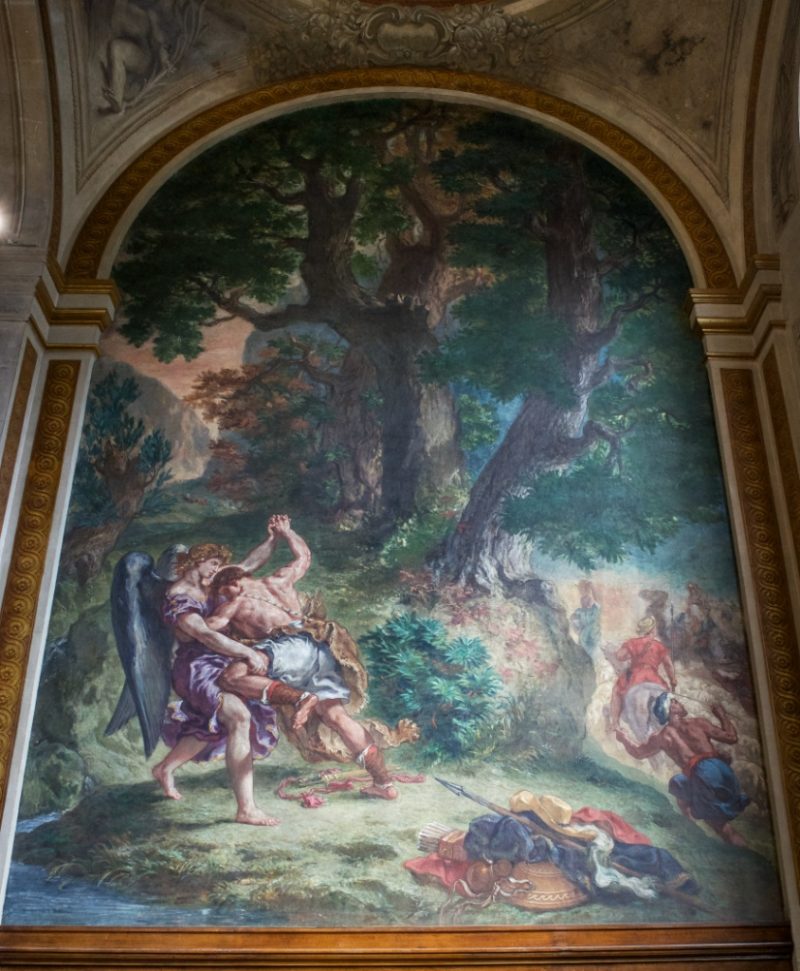
Friends and acquaintances suggest that what Julius needs is a holiday. In his obliging manner, he attempts to re-visit the joys of his youth, when he sampled the delights of brief getaways in Paris with obliging young women. It doesn’t take long to get to Paris from Waterloo…but the people have changed and of course Julius has too. He feels his age and decides to return home earlier than planned. Before he leaves, he pops into Saint Sulpice to check out Delacroix’s painting. I’ll leave you to read the book and find out the epiphany or new reading that Julius takes away with him from the viewing.

I always feel a wee bit more edu-muckated after I’ve read Brookner. I learn new words – this book brought me meretricious, which I always forget means “befitting a harlot – or showily attractive” – a most useful word – must use it more often. Then of course there is fiacre – which you might think is something to do with a fiasco – but no, it is a French four-wheeled cab – never enough cabs I say. Finally inanition.- emptiness esp of nourishment i.e. how I felt earlier this week after a particularly nasty tummy bug.

In conclusion I have to say that on the whole I found The Next Big Thing a bit of struggle – rather like Jacob wrestling with the Angel. There is a very telling line early on when Julius forms a friendship with a younger man – a co-beneficiary of the estate bequeathed to them. They dine together on a regular basis “Herz had little experience of dealing with younger people but understood instinctively that one kept out of their lives as much as possible but was curious and indulgent towards them….It was a matter of discretion not to talk about oneself. To do so would be to shock Simmonds with the prospect of what awaited him.”

I guess I’m not shocked. More gloomily depressed. One doesn’t want to shoot the messenger of course, but it has to be said that Brookner fare puts you off old age, so she does.

Guest Review: Hotel du Lac

[Another Cookie Crumbles offers us her thoughts on Hotel du Lac.]

Belated birthday wishes to Anita Brookner, and a day late, but a happy International Anita Brookner Day to the rest of you.

Some time back, I decided to re-read Anita Brookner’s Booker-winning Hotel du Lac a few months back, as part of Sarah’s Not A Rat’s Chance In Hell, and last week seemed to be the right time to read it (what with 16th July being IABD.

I enjoyed Hotel du Lac the first time I read it, when I was still in my teens – the pathos, the despair, the richness of characters and the fact that it is set in Switzerland. Switzerland is, by far, my favourite country in the world, and I intend to live there at some point in my life. It just feels like… home.

The re-read, however, wasn’t quite the same experience. I felt myself getting slightly more frustrated with Edith’s character, and her complete lack of proactivity. It was almost like she was resigned to her fate, and was letting life pass her by; letting other people pull her strings.

Edith, an established writer, has been exiled to a hotel by Lake Geneva. Her friends have advised her to “disappear for a decent length of time and come back older, wiser and properly sorry,” for an act that she has committed, albeit it isn’t quite clear what that act is, in the opening pages of the book. In the hotel, she meets a myriad of characters, each seeking a break from reality, and as she gets to know them better, we (as readers) get to know our protagonist better as well.

What it had to offer was a mild form of sanctuary, an assurance of privacy, and the protection and the discretion that attach themselves to blamelessness.

Edith is in love with David, a married man, but her affair with him is not the reason behind this exile. And, it’s not her absolution. She writes letters to David regularly, and yearns for his presence, which doesn’t seem forthcoming. She attempts to return to her writing in the hotel, but the characters that surround her distract her – mostly, the women, but there is the one man who catches her eye? Or, does she catch his eye?
The women in the hotel, which is indeed very selective of its guests, include the extravagant superficial Puseys whose interests most involve shopping and living an expensive lifestyle; Monica, who seems enviously condescending of the Puseys, as she spends her days sharing coffee, ice-cream and cakes with her dog; and Madame De Bonneuil, an old lady, who’s been abandoned by her son after his marriage. Then there’s Mr. Neville, a self-proclaimed romantic who thinks he’s good for Edith…

A lot of the book focuses on women, and how their stature evolves with age and marriage; the importance of marriage and of having the significant other. Of course, this is predominantly due to the time in which the book was set – possibly the 70s – but subjecting all women to such… banality… was what got me slightly annoyed. A woman’s place in society should be incidental to her marriage, not a result of it – that’s my verdict, but then again, I live in the twenty-first century, so it is easy for me to say that.

The company of their own sex, Edith reflected, was what drove many women into marriage.

Brookner does pull out a couple of good twists though, which almost saves Edith’s character, for she does come across as a passenger in her own life, not an active participant – definitely not the driver. It was well-written and slightly humorous, but, despite being under two hundred pages, oh-so-slow, that it almost feels like a book you want to curl up with, a glass of red wine in one hand, and the Moonlight Sonata playing on the stereo.

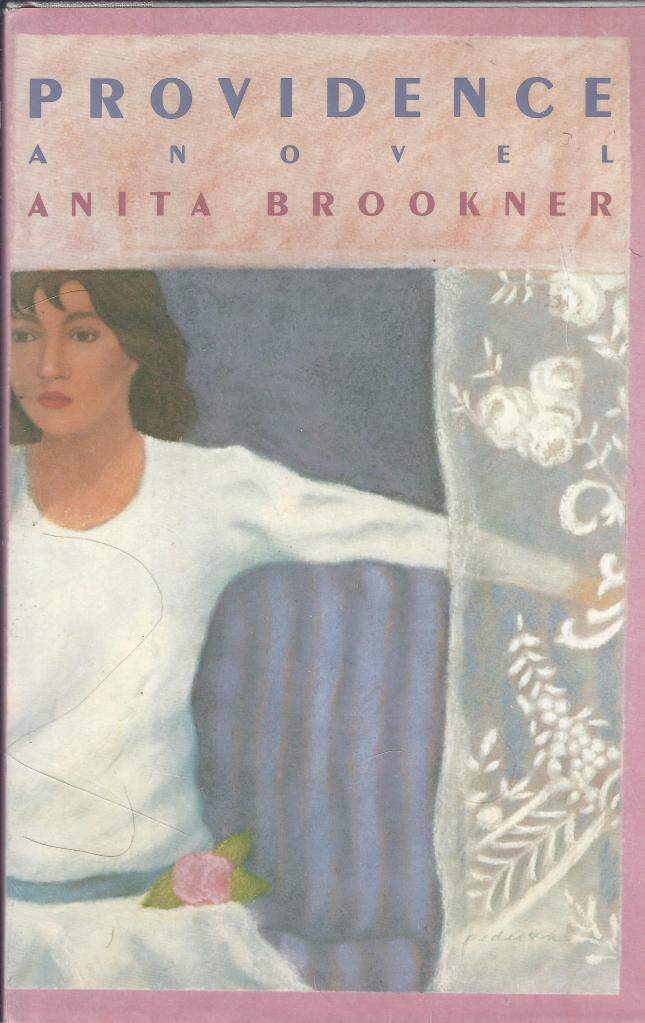
Review: Providence

Never before have I re-read a novel so soon after the original read. But since I am re-reading all of Brookner’s novels in chronological order, Providence was the next one in the pile—even though I read it for the first time just over a year ago. Even more unusual for me is to write another review for the same book without just saying “ditto”. But second reads give us so much more to think about, so this won’t be too challenging. Right?

Kitty Maule is a lecturer whose specialty is the Romantic tradition. Her unrequited love for her colleague Maurice sets up a cognitive dissonance between the independence and drive that helped propel her career, with the urge to set it all aside for the privilege of being Maurice’s wife. In her professional life, Kitty leads three students through a close reading of the novel Adolphe written in 1806 by Benjamin Constant. The “action” in Providence includes classroom discussions of Adolphe and the Romantic tradition which are easy enough to take in without knowing anything, or much, about either. But, as Providence would have it, just as I was finishing up my re-read of Providence I got my delivery of the 37 novellas that make up The Art of the Novella series from Melville House Publishing. And amongst those 37 volumes was none other than Adolphe by Benjamin Constant. And even though I was meant to save these novellas for August when I will be participating in TAOTN challenge, how could I not read Adolphe now to better round out my experience of Providence? (Does this count as wading into comparative literature?)

Adolphe can be easily (and crudely) summarized thusly: For the first third of the book Adolphe seeks to win over the love of Ellénore. He spends the final two thirds trying to break up with her.

At first glance the two works have a few things in common. Both Kitty and Adolphe are seemingly ruled by reason and calculation yet both find themselves subject to swings of passion that cancel out much of their rational thinking. Kitty’s classroom explanation of Adolphe’s behavior could just as easily be applied to Kitty:

‘…it is characteristic of the Romantic to reason endlessly in unbearable situations, and yet to remain bound by such situations…For the romantic, the power of reason no longer operates. Or rather, it operates, but it cannot bring about change.’

And both Brookner and Constant use language that is rather staid compared to the turmoil it describes. Again, Kitty’s exegesis on Constant could apply as easily to Brookner:

…the potency of this particular story comes from the juxtaposition of extremely dry language and extremely heated, almost uncontrollable sentiments…[T]here is a feeling that it is almost kept under lock and key, that even if the despair is total, the control remains.

And there is more than a little connection between the two works in the fact that Kitty’s behavior towards Maurice is a more modern, less dramatic version of the theme that Kitty abhors in Adolphe. It is only for the sake of studying the juxtaposition of classicism and Romanticism that Kitty overlooks:

…its terribly enfeebling message: that a man gets tired of a woman if she sacrifices everything for him, that such a woman will eventually die of her failure, and that the man will be poisoned by remorse for the rest of his life.

Of course the modern twist means that Kitty doesn’t get to die of a broken heart, and Maurice, most certainly feels no remorse.

So what then of Providence in both Providence and Adolphe? In Brookner’s novel, the idea plays out in Maurice’s belief in Providence as well as in Kitty’s conflict between her non-belief and her flirtation with that which is outside her control. What else could explain her visits to a fortune teller and her reluctance to accept the reality of her relationship with Maurice? But I think the more interesting aspect of Providence and the one that plays out in both Providence and Adolphe, is in how the objects of female desire, Maurice and Adolphe, play the parts of Gods. Not in the sense of being the objects of worship or adoration (although there is an element of that). But rather they both usurp the role of the guiding hand in the way they actively manipulate the desire of Kitty and Ellénore, and indeed control their destinies. One could argue that it is still Providence at work but really it seems more to me like they are being toyed with by self-centered men. In the case of Adolphe his motivation seems to be purely ego and boredom. With Maurice you can add to that the fact that he wants a hot meal every now and again.

After re-reading the passages in Providence that dealt with Adolphe explicitly I couldn’t help but think that the title of Brookner’s book could have been Alienation. Through the lens of Kitty’s discussion of Adolphe’s feelings of alienation, it struck me that Kitty’s big problem was less to do with Providence and more to do with her utter sense of alienation. Alienated from her colleagues, her country, her ethnicity, her aging grandparents, her dead mother, her father who died in the war without ever knowing his daughter, and even from the fashion of the times. In the end, her academic career, perhaps the thing that most alienates her from all the rest, is the only thing she has to hold on to.

A Brookner Birthday Bio

[JoAnn at Lakeside Musing offers this great mini-bio of Anita Brookner for those that don’t know much about the author.]

From Writer’s Almanac for July 16, 2011:

It’s the birthday of the novelist who said, “I feel I could get into the Guinness Book of Records as the world’s loneliest, most miserable woman.” That’s Anita Brookner (books by this author), born in London (1928). She writes novels about lonely characters, so everyone wrongly assumes that she is writing about herself. She said: “Well, I am a spinster. I make no apologies for that. But I’m neither unhappy nor lonely. I am interested in people who live on their own, people who get left behind, who drop through the net, but who survive. They seem to me quite heroic characters sometimes, but no one inquires about them because they’re people who do without much conversation, whose loudest moments are internal.”

She did have a lonely childhood; she had no brothers and sisters, and her parents were unhappy. Her father was an unsuccessful businessman. Her mother had given up a successful career as a singer to marry her father and was never sure that it was a good decision. Anita loved reading and art. Her father gave her two Dickens novels every year for her birthday and Christmas until she had read every single one. The Brookners lived near an art museum, and she spent every Sunday afternoon there looking at paintings.

She went to college and graduate school to study art history, which worried her parents; they were concerned that she would never find a husband if she became an academic. When she insisted anyway and got offered a scholarship to study in Paris, her parents disowned her. But she loved Paris. She said: “I lived in a hotel, which is an ideal existence. You have no responsibilities. You eat out; you don’t make your bed. You go off to work every morning; and I was completely immersed in the work. I’ve never been so happy.”

She moved back to Britain and became an art historian and professor. For many years, she was a popular and respected teacher, but when she was in her 50s, she started to worry about what she would do after she retired. She liked to read fiction, so she decided to try writing a novel. Her first novel, A Start in Life (1981), was published when she was 53. After that, for many years she published exactly one new novel every summer. She writes her novels out in longhand, then types them up, and writes only one draft. Overall, she has published 24 novels in the past 30 years. She said, “My real work was as a teacher and an academic, and I loved it. This is really just filling the time.”

Her novels include Hotel du Lac (1984), which won the Booker Prize; Undue Influence (1999); The Rules of Engagement (2003); and most recently, Strangers (2009).

She said, “I suppose what one wants really is ideal company and books are ideal company.”

Guest Review: Bay of Angels

[Despite her self-doubt, Michelle Foong from Selangor, Malaysia has provided a review of The Bay of Angels as good as any blogger.]

Hope I am not too late in submitting my entry! Just managed to finish my first Brookner two hours ago, phew…. I am not a fast reader plus I lack the discipline to stick to one book before dipping into another (I get distracted easily by the lure of other books calling out from the shelves…. ) Anyway, I am so very glad that you and Simon had set a date for this event, thus forcing me to somehow get down to finishing the book in a week! That’s a record of sorts for me :p

Okay, enough preamble, let’s get to the book. Given a choice, I would have liked to start of my acquaintance with Ms. Brookner through Hotel du Lac. Not simply because it was a prize winning book, and that would somehow suggest a promise to showcase Brookner in one of her best forms, but because I was genuinely interested in the themes the storyline seemed to offer. But as providence would have it, I stumbled upon an almost pristine copy of The Bay of Angels at a books clearance sale and got it for only RM1.20 (that’s equivalent to about 0.40 USD!) Although the blurb on the back of the book didn’t quite interest me and it wasn’t the kind of story that I would go for, the cover of the book certainly did otherwise (and let’s also not forget about the price…)

And so, that is how it came to be that my first personal encounter with Ms. Brookner’s brilliance, is by way of the Baie des Anges.

I am not a blogger. Neither am I good at writing reviews. Therefore, I shall leave it to those who are better skilled and more eloquent to do so for the book. They will probably do better justice to the book than I can. What I would like to share instead, are my thoughts and the reading experience it gave me. It was probably not merely by chance that I ended up being “made” to read The Bay of Angels despite my initial feelings about how the storyline would not appeal to me much. I say this because once I had started reading, I began to realise how well I could relate to the feelings, the thoughts and the emotions of Zoe, the protagonist in the book.

Like Zoe, I too have a clear understanding of what it feels like to be alone. To find comfort and safety in solitude. To lead a life that seems “not the norm” and maybe even “pitiable” or lacking, in the eyes of those whose value systems are different from ours, those who equate happiness and contentment with what the world in general defines it to be. The ability to put on the right masks at the right time and place, in order to blend in and not invite any further unwelcomed scrutiny. And like Zoe, I too have felt the constant antagonistic struggle between the trappings and burdens of familial duties and the yearning for freedom. But unlike Zoe, who in her own words “has no belief in God”, I do. And it is because of this, that I can be alone, and yet know that I am not alone. I can have little, but with contentment, yet find that it is great gain. The fear of having no witness in her life as the days go by, the fear where “one would be more alone in death than one had ever been in life…”  as she ponders on the mystery of death while recalling the preoccupied expression on her dying mother’s face which would haunt her for ever, all of which I believe would have been very different for Zoe, had she had a personal relationship with God. Reading this book has made me realise what my faith and belief does for me, in terms of coping with the demands and pressures of everyday living. I thank God for providing me with deep reserves, from which I could draw upon freely, and not just have my own resources to rely on. I wish that Zoe had known that for herself. I wish the same too for all who are struggling through life’s tough terrains thinking that they have to shoulder it all upon themselves to make it through. They don’t. There is a choice. 

I really appreciate and love the subtlety and sensitivity in which the many difficult themes and issues are handled and portrayed in the writing. The cleverness and beauty of putting into few words that which speaks volumes. That which has been left unsaid does not remain silent. Ms. Brookner has proven that the less can indeed be more. And I have a feeling that I will be looking out for more of her works from here on, after getting off on what I would say is, a good start. 🙂

So, thanks again, for having this event, and for introducing me to a writer that definitely deserves to be more widely read.

Guest Review: Look at Me

[The following review of Look at Me was written by Frances at Nonsuch Book.]

Jonathan Yardley picked an Anita Brookner title for me for IABD. Well, not personally, but the process of choosing just one proved too daunting so I turned to searching through the opinions of others to find a title that was a bit more than just the piercingly perceptive depictions of loneliness for which Brookner is so well known. And then I found a piece from the Washington Post in 2005, one of those Yardley contributions I enjoy so much where he reconsiders a “notable and/or neglected book(s) from the past.” Where he looks beyond the psychic isolation of Look at Me protagonist, Frances Hinton, to the thoughtless treatment she receives at the hands of careless people, people Yardley compares to Daisy and Tom from The Great Gatsby. “It was all very careless and confused,” Fitzgerald writes. “They were careless people, Tom and Daisy – they smashed up things and creatures and then retreated into their vast carelessness, or whatever it was that kept them together, and let other people clean up the mess they had made.”

Frances leads a quiet life contained within an inherited flat with inherited possessions with a housekeeper that she also did not choose, and ventures out for few things other than her work in a small medical research library. When her life is touched by the beautiful and fun-loving Alix and her equally appealing husband Nick who works as as a doctor at the same institute as Frances, she comes alive with the possibilities of life and permits this couple to treat her as an object of entertainment and an occasional funder of their merriment. They pair her with James, another doctor from work, with whom her sensibilities mesh, and her contentment elevates her out of loneliness. Until the bright and beautiful cease to find her amusing anymore.

Even as Frances recognizes the casual disdain with which she is treated, she still seeks to preserve her inclusion in the social circle of her new friends.

I could have been different, I think. Once I had great confidence, great cheerfulness; I did not question my purpose or the purpose of others. All that had gone, and I had done my best to replace it. I had become diligent instead of spontaneous; I had become an observer when I saw that I was not to be allowed to participate. I had refused to be pitiable. I had never once said, Look at me. Now, it seemed, I must make one more effort, one more attempt to make myself viable. And If I succeeded, I might be granted one more opportunity to do it all over again. I did not dare to think what would happen if I failed.

So what she requires from this relationship with the careless is not to possess them, to become them but to regain possession of herself. In an odd way, she uses them as much as they use her especially in her frequent relegation of the cast of characters around her to mere subject material for her writing. But she does this only from desperation in an attempt to claim a voice in a life that has not readily afforded her one.

I saw the business of writing for what it truly was and is to me. It is your penance for not being lucky. It is an attempt to reach others and to make them love you. It is your instinctive protest, when you find you have no voice at the world’s tribunals, and that no one will speak for you. I would give my entire output of words, past, present, and to come, in exchange for easier access to the world, for permission to state ‘I hurt’ or ‘I hate’ or ‘I want.’ Or, indeed, ‘Look at me.’ And I do not go back on this. For once a thing is known it can never be unknown. It can only be forgotten. And writing is the enemy of forgetfulness, of thoughtlessness. For the writer there is no oblivion. Only endless memory.

The observations of self and others flow in an exhaustive flow of pent-up release. An observant mind that finds no occasion to share her thoughts freely except on paper. Juxtaposed against the excesses of speech and action in the careless, this is a jarring reminder to allow oneself to hear the unsaid, to see the unseen certainly not out of misplaced pity but in order to connect to a broader consciousness. A stunning and elegant book.

Guest Review: A Private View

[The following review was written by Jack at This Windy Sea of Land. He actually started his blog just so he could participate in IABD.]

I’ve never reviewed a book before, but I have been, if not hardcore, at least an interested Anita Brookner fan ever since my first encounter with Hotel du Lac (1984) at my mother’s recommendation when I was 16.  These books, however, as almost anyone who has read one would admit, are not for everyone: critics often accuse her of writing the same book again and again. What is more, critics often accuse her of writing depressing books, about a lonely woman leading a non-eventful life (coincidentally aging between books at about the same rate as the author herself), pondering her loneliness for 200 pages in magnificent detail, again and again. To quote the immensely witty and self-aware opening line of Incidents in the Rue Laugier (1995), these women “read a lot, sighed a lot, and went to bed early”. And to be fair to these critics, this is not far off the mark.  In an interview with Mick Brown (The Daily Telegraph, 2009) after the release of Brookner’s most recent book, Strangers (2009), Brown retells an anecdote told by one of Brookner’s friends:

Julian Barnes remembers lunching with Brookner and asking what she was working on at the moment. ‘And she said, “I’ve just finished a novel.” There was a perfectly judged pause, then she added, “It’s about a lonely woman…” And gave me a very direct glance.’  

“I think one keeps on writing the same book over and over again,” she said. Her own understanding removes all power from those who take the easy route of sneering at the superficially banal nature of her (non-existent) plots. Brookner writes to “fill time”; she is the lady amateur. This self-awareness, however, forces a reader to address her work on a different level. A reader must take into account the intelligence of the author- leading to an understanding that Brookner is beyond reproach both because of her modesty and because of her sheer talent. Her pages are filled with poetic prose that, although often compared to Henry James, reminds me equally of Virginia Woolf; her clean lines and careful structure chart the lives of women (and occasionally men) who seem always to live in the dream like bubble of their own minds paradoxically separated from the outside world by divisions as clear and strong as the boundaries in a classical garden.
A Private View (1994), however, is somewhat different; for one thing George Bland, our recently retired and occasionally infuriating, protagonist is a man. Bland even has a friend he feels comfortable with; Louise, his one love affair who married another man but who, now a widow, calls him every Sunday night; phones calls of comfort, if not of passion. However, George had planned to spend his retirement travelling with his closest friend, Putnam, who died before the great plan could be realised. At last, one may think, he is lonely! It is definitely an Anita Brookner novel! Yet in the novel’s plot a gulf is exposed between this novel and Brookner’s others.

Katy Gibb appears in Bland’s block of flats. A young and, one may even say, feisty woman claiming to know the Dunlops, Bland’s neighbours, currently away on holiday. They’ve promised, she says, that Katy could stay in their flat. Bland, the guardian of the Dunlop’s keys reluctantly, and perhaps foolishly hands, them over, wishing only for the quiet and secluded life of any other Brookner character.  Katy, however, is less willing to go away. She infiltrates Bland’s life one step at a time; she calls him George in a gross breach of the rules of address that dominate so many character relations in the novel, she invites herself round to his flat for tea. Through this a reader eventually learns that Katy is vying for more than his company; rather she seeks his large and comfortable flat. She is after premises in which to establish her new-age health business. It is in this aspect that we see the greatest distinction between this novel and Brookner’s other recollections of melancholy: whereas her characters normally leave home, heading usually to France or Switzerland to read a lot, sigh a lot and go to bed early, Bland has his life invaded. He does not flee and is forced further into his own flat rather than, as is usual, out of it. Like an Elizabethan house, greater privacy is found further inside as his external rooms are invaded by new-comers until only one room truly remains: “his bedroom, his fortress.”

It would perhaps not be too far to see both Bland’s flat and Katy as two sides of a coin: one comes to represent Bland’s mundane, comfortable and routine existence, the other a lust for adventure and travel as Katy seems to possess the complete freedom to journey that Bland had hoped for in his retirement plan. He had hoped to journey to the Far East, with Putnam, “by the slowest route they could devise”. Instead he falls in what he believes to be love. Asking for pecuniary investment for her new business venture Katy declares: “After all, I’m the potential, aren’t I? I’d be the investment.” She is just that. The potential; the potential life that Bland could lead, alone and carefree. It might not even be too far to suggest that she is the potential of an empty flat. The Dunlops’ absence creates new life, albeit unintentionally. Katy comes to be the spirit of freedom itself and, to a certain extent, Bland seeks to be her. Caught up with her petulant mystique of extravagant eating, so out of line with “the instinctive frugality of those who live alone, financially secure though never extravagant” (Leaving Home, 2005),and with her rude questions (“Anywhere exciting?”), Bland reaches the most infuriating heights of desire ever captured in novel form. To use an ancient cliché, he is in love not with Katy (who he states he would feel embarrassed undressing in front of) but with the idea of Katy. In reflections back to his mother’s invasion of his stuffy childhood bedroom- going in when he was away, shutting his window and smoking, filling his private space with her essence- Bland sees the similarities between the two women. Both invade his space and, to a certain extent, “bring him up”; Katy educates him. However, as his mother dragged him from university to work in the, metaphorically significant, cardboard-box factory, Katy too confines him. Within his generation. She pities his age and, as such, forbids him access to her free way of life. However, it is perhaps in Katy that we see the “standard” Brookner heroine, rootless and lonely. It is maybe for her that we should feel pity. She seeks the security of a “room of her own” rather than the borrowed accommodation of absent “friends”. Bland, however, sees only her current life and longs for it as both parties seem desperate, although they hide it, for what the other has.

Bland, in love, recognises, but refuses to admit, the inadequacies of the, actually non-existent, relationship. Neither partner considers the other their equal. Forced into greater seclusion Bland recognises the importance of his relationship to the world. Thus his dream is over, rightly crushed by pragmatism. Katy, denied Bland’s flat- denied Bland’s place in the world-, is to return to America. In keeping with the tried and tested Brookner technique, the net result is zero. No change. “Nothing had changed but everything had changed”, Zoe’s maxim from The Bay of Angels, holds true. Bland, as his name suggests, does not rock the boat and stays within the confines of his regular existence. “Now I must live my life as I have always lived it”, he declares to himself. This is not to say, however, that he remains as internalised as his contact with Katy had made him. There is no longer any pressure from youth or from his own mind, as in other Brookner novels, to be a complete recluse. To Louise he asks in the closing line of the book, “What would you say to a cruise? In the Spring?”. The novel ends with hope; it ends not with death but the potential for new life. Not the wild life of Katy Gibb but a life more appropriate to Bland’s place in society and his stage of life.

It doesn’t really feel like I’m giving the ending away; this is what one expects from a Brookner novel. The Dunlops’ return to their flat over the corridor signals the end of a purely internal and mental adventure as Bland faces his own life and his own choices reflected in the elusive Katy Gibb. Bland is literally forced into his comfort zone, his bedroom, as the outside world (death, other people) encroaches on his own personal reality. It is within himself that he sees the choices he could have made as he almost acknowledges the Katy Gibb residing in himself:

For a brief moment he was afforded a glimpse into the heart of hedonism, something ancient, pagan, selfish. He saw it as movement, headlong rush, carelessness, the true expression of the essential ego.

Ultimately, however, this glimpse confirms Bland’s understanding of his own existence.

His life, in retrospect, seemed very long and quite uneventful. Yet it had been occupied with struggle, with the no doubt modest but nevertheless taxing struggle of finding a place for himself in the world.  

Nothing may happen in any of Anita Brookner’s novels, but they are not all the same; each “hero” must struggle to find their own, distinct, reality.

Guest Review: A Closed Eye

[Ted from Bookeywookey brings us this review of A Closed Eye. And I am automatically impressed by anyone whose life includes neuroscience.  Let’s see what he thinks of Brookner.]

I’m really pleased that Thomas and Simon gave me an excuse to read another of Anita Brookner’s novels. In a certain way A Closed Eye (1991) is the kind of story I expect from Brookner: a repressed English woman becomes aware that she is not living her live fully, she meets opportunities to change that, and she reflects on it (I won’t say whether she does change it or not). What is notable about the two Brookner books is I have read is, given this formula, they are not banal but rather involving and surprising. Here the devil is in the details.

Harriet, has a strawberry mark on her face, but is born to outgoing parents, determined to enjoy life.

They were so young, so dashing, that Harriet’s birth passed almost unnoticed. Except, ‘Oh, Lord,’ said Merle, when shown the baby. ‘It may fade as she gets older,’ said the nurse, pulling the shawl a little tighter round that baby’s face, where the red mark appeared so incongruous beneath the wise innocent eyes. Merle felt for her, as well as love, a kind of reluctant pity, almost a distaste. She was glad to leave the child with her nurse and to put on the little black dress, the fur cape, and the cocktail hat to go off to her young husband, equally dashing in his air force uniform, with the officer’s cap pushed back from his forehead, and the white silk scarf draped carelessly round his neck. How they drank! How they danced!

And so, as if in response, Harriet grows up retiring where they are spirited, practical where they are frivolous. She makes three friends: Tessa, Pamela, and Mary, but assumes their friendship is almost a form of pity. She spends evenings reading. She goes to secretarial school and takes pleasure in a day’s typing. She is introduced to a contemporary of her father’s – Freddie. They marry. Her mother, Merle, worries that Freddie is too old. Her thoughts sing a Brooknerian tune:

Her own marriage, which had begun so rapturously, had ended in disappointment. Privately, she wondered if all women were disappointed, and concluded that this was probably the case but was never admitted. She felt better when she had managed to persuade herself of the truth of this. The prospect of spending money, after the years of careful parsimony, cheered her considerably, and in a while she forgot about Harriet, for the furnishing of the new flat made her feel as if she were the heroine of an adventure, a fresh start, while her daughter, who looked on solemnly and without comment, seemed oddly static, as thought the roles were reversed and she were now the adult. Sometimes Merle hid the prices on the articles she now bought so feverishly, as if Harriet might disapprove and order her to return them to the shop.

It is Tessa “tall and fair and commanding” of whom she is almost enamored. Tessa marries Jack Peckham, a handsome man who travels the world, wears his hair long, and his beard unshaven. It is Jack whom awakens in Harriet desire for something outside the bounds of her stoic existence.

When Harriet first saw Jack Peckham she put up her hand, instinctively, to shield her face. With no one else had she ever done this. The gesture was symbolic, as if she were hiding more than her face, as if she were hiding herself, for she recognized in him the stranger of her dreams, and in the light of day did not wish to be found.

Brookner is brilliant at these sort of gestures. It like something an actor would discover in playing a character, or a painter would capture. It’s the moment of a person distilled into a single movement, which Brookner then revisits as a kind of refrain. It is the pleasure of the book to read what Harriet does regarding Jack, but how it functions in the novel’s progress, I can tell you without a spoiler. It slaps Harriet into the arena of the living. It exposes her to the risk of, as Brookner so bluntly puts it “succumbing to self-knowledge.”

This is a novel of comparisons. Comparison of Harriet to her parents, to Tessa, and then when Tessa has a daughter – Lizzie – and Harriet has Imogen – the next generation seems to repeat it, only with ironic variation. Lizzie becomes the reclusive reader – socially ill-at-ease, and Imogen selfish, willful, indulged, and domineering. Lizzie, in fact, becomes a foil of Harriet, but she is not trapped by the social conventions of the 1950s and doesn’t have to marry. She is determined, she awkwardly but self-possessedly informs Freddy when still a teenager, to become a writer.

‘But not straight away, not until I’m old.’ ‘How old?’ Harriet had persisted. ‘Forty,’ was the answer. Freddie, behind a newspaper, had laughed; he was already over seventy. But Harriet had taken her seriously. ‘You will have to travel, I suppose, and have lots of interesting experiences.’ ‘Oh, no,’ Lizzie had said. ‘It will all come out of my head.’ That was all that she would say.

Here is a different version of whom Harriet could have become. Someone who knows herself and finds a purpose for her quietness, her desire to remain apart, her love of books, and her talent to observe. I suppose it’s inevitable that, in this passage, she becomes the representative of Brookner herself. The writer who chronicles reclusive bookish women and who doesn’t start writing until mid-life. Although, Lizzie tells us, her work will be invented – so we shouldn’t apply her story too literally.

This book, like its subject, has a quiet and intelligent surface, beneath which the hungers of life have been kept at bay by a combination of some innocence and also subtle self-deception – the ‘closed eye’ referred to in the title, and borrowed from Henry James, whose writing many think Brookner’s evokes. In A Closed Eye these hungers are brought to a boil. The novel’s elegance is in the structure of opposites Brookner constructs – bold and shy, indulgent and austere – these become partners in a dance of gains and losses. A dance to the music of repressed passions. Better a life that is modest, considerate, and half-lived, or one careless of consequences, but where one strides boldly, unafraid of asking and of taking? Or is there a third route? One of patient observation, satisfying work, and pleasures taken in the solitary company of one’s imagination? But then, what of love?

Guest Review: Hotel du Lac

[The lovely Polly at Novel Insights has provided the following review of Hotel du Lac.]

Romance novelist Edith Hope arrives at the Hotel du Lac following some act of shame which is undisclosed at the outset of the novel.

What it had to offer was a mild form of sanctuary, an assurance of privacy, and the protection and the discretion that attach themselves to blamelessness.

She believes that the hotel will be a place of safe-harbour where she can continue with her writing and take a break from the people who resulted in her exile there. The other hotel guests become a source of interest for ‘bloomsburian’ Edith. Mrs Pusey (an ‘enchantress’) and her daughter  (‘odalisque’) Jennifer draw Edith into their superficial confidence and is a source of fascination for the writer. Their curious intimacy, their ability to find contentment in pretty purchases and strange kind of power draw Edith in.

…there was something soothing in the very existence of Mrs Pusey, a woman so gentle, so greedy, so tranquil, so utterly fulfilled in her desires that she encouraged daring thoughts of possession, of accumulation, in others.

She also meets “Lady X” owner of neurotic Kiki the lapdog. She has an ethereal quality as a result of her sinewy frame and way of moving and later her name is revealed – Monica. An elegant woman with a sharp tongue, she seems faintly disparaging of the Puseys and their simple extravagance.

Midway through the novel, it becomes apparent that a certain Mr Neville has turned his attentions to Edith and with his candid tongue he courts her in his own uniquely practical way. Can this man save Edith from her self and the life of spinsterhood that everyone else seems to be foretelling for her? What did Edith do that was so shameful?

Hotel du Lac is a curious novel. It didn’t completely grab me at initially. I was drawn in by the first couple of chapters and the wonderful descriptions of the hotel and its residents on Edith’s arrival, however with my distracted mind I kept finding that I had read a page and not absorbed the content – (which is curious as this happens to the protagonist in the book itself!). A small warning that this is a slow book despite its short length. You need to marinade in it – stop and read the sentences with care absorbing the atmosphere and looking through Edith’s lens.

About halfway through Hotel du Lac, really began to click with me and I began to feel as if I was really getting under Edith’s skin. I curled up with a blanket safe from the patter of rain-drops outside and gave it my undivided attention. I began to really feel Edith’s sorrow, her need for re-assurance and really enjoyed her observations – sometimes admiring, sometimes sharply critical as a pin. I began to warm to this woman exiled by her friends, crippled by her own self-doubt and the weight of others’ opinions. I loved the idea of Edith’s stay at the hotel being a sojourn, a place where she finds out who she is and who she doesn’t want to be. The ending was dryer than a gin and tonic and just as refreshing, leaving a smile on my face and a feeling of pride for Edith.